
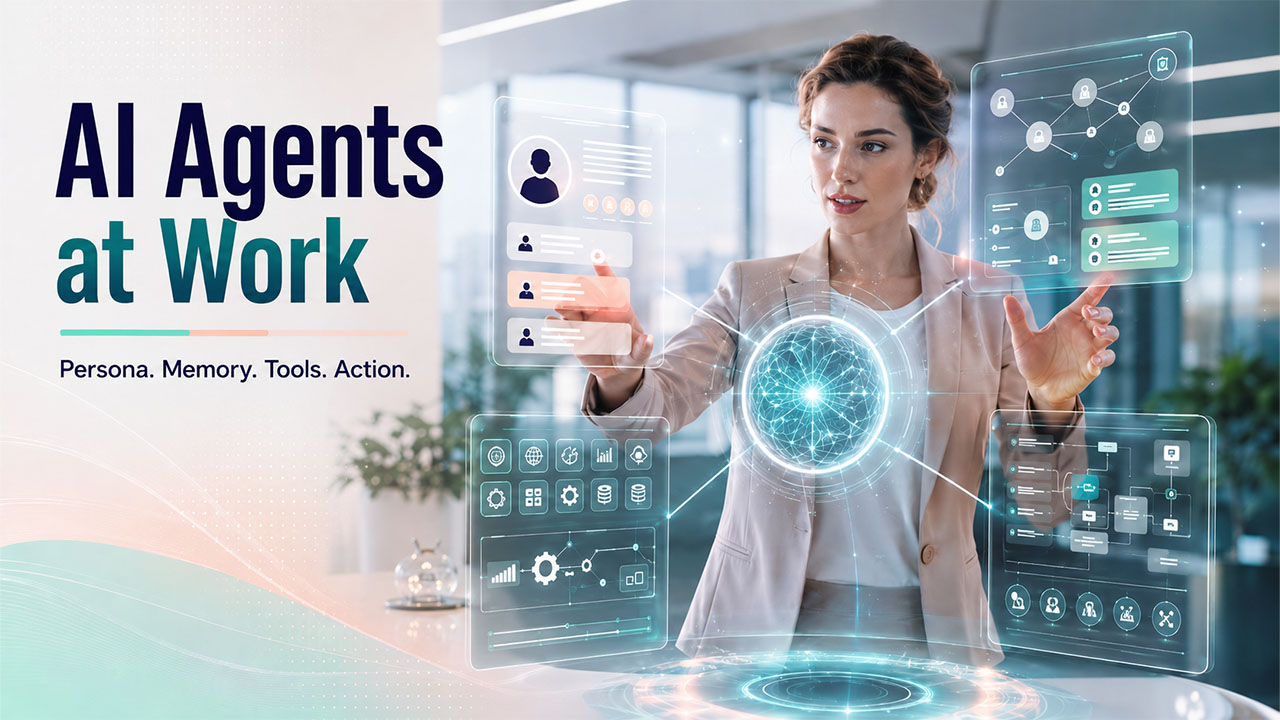
AI Agents are software systems that utilize AI to complete tasks and reach goals on behalf of users. They show skills like reasoning, memory, and planning, and can autonomously make decisions as well as learn and adapt. Their capabilities, by and large, originate from the multimodal capability of generative AI and AI foundational models. AI agents can easily process multimodal data such as text, voice, audio, video, code, and can simultaneously reason, converse, learn, and make decisions. Advanced AI agents can develop complex skills over time and can also complete transactions and business processes. These agents can also collaborate with other agents to coordinate with one another and perform more complex workflows.
If you are familiar with the fundamentals of Artificial Intelligence, it will be much easier for you to understand features and concepts that drive AI agents.
What Are the Main Features of an AI Agent?
As mentioned above, while the main features of an AI agent are reasoning and acting, as a conference paper at ICLR 2023 suggests, it also comprises additional features. Let us take a look at the key features of an AI agent:
Reasoning:
This core cognitive process includes using logic and available data to draw conclusions, solve problems, and make inferences. AI agents with strong capabilities of reasoning can assess data, recognize patterns, and make data-driven decisions as per the context and evidence.
Acting:
The capability to perform tasks or take actions as per the plans, decisions, or external input is vital for AI agents to interact with their environment and reach their objectives. This can involve physical actions in case of embodied AI, or digital actions such as updating data, sending messages, or analysis of sensor data.
Observation:
Collecting data about the situation or environment through sensing or perception is vital for AI agents to interpret their context and make data-driven decisions. This can involve different forms of perception such as natural language processing, computer vision, or sensor data analysis.
Planning:
Creating a strategic plan to achieve objectives is an important facet of smart behavior. AI agents with strategy capabilities can recognize the important steps, assess possible actions, and select the best course of action based on desired outcomes and available data. This generally involves forecasting future states and considering possible challenges.
Self-refining:
The capacity for adaptation and self-improvement is an intrinsic aspect of sophisticated AI platforms. Collaboration needs coordination, communication, and the capability to interpret and respect others’ perspectives.
What Are the Key Concepts Behind Agentic AI?
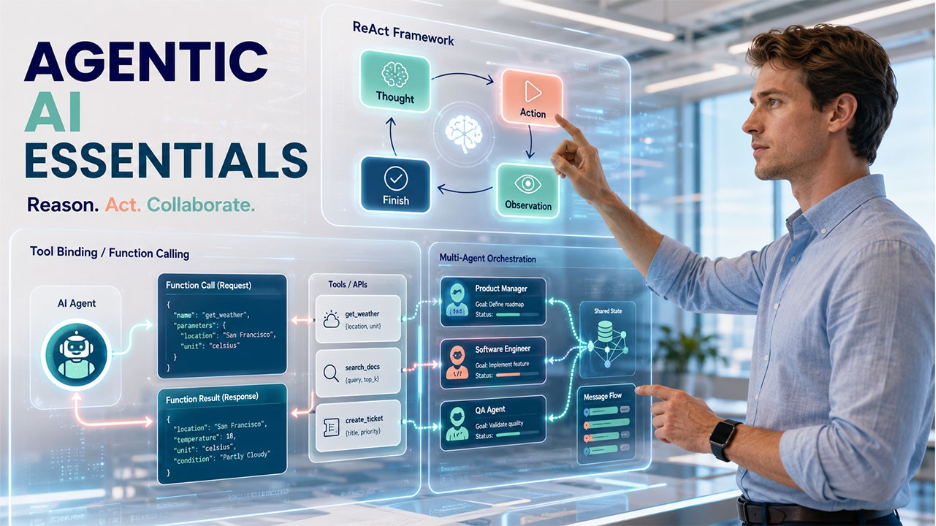
In order to truly grasp the development of AI agents, engineers must be familiar with the foundational principles of prompt engineering and system architectures that enable an LLM to behave agentically.
The ReAct Framework-
The ReAct (Reasoning and Acting) framework is possibly the most vital paradigm in the development of an agent. As the researchers have introduced, ReAct interleaves traces of reasoning with actions specific to a task. Instead of just predicting the final answer simply, the agent creates a sequence structure strictly as:
- Thought: The agent explains what needs to be done.
- Action: The agent decides what tool to use as well as the input variables.
- Observation: The system executes the tool and gives the raw output to the agent.
This loop continuously repeats until the “Thought” of the agent sees that the final objective has been met successfully, at which point it executes the final “Finish” action.
Tool Binding and Function Calling :
Modern large language models, specifically the ones that are fine-tunes for agentic workflows, are trained on datasets comprising API schemas. Function calling refers to the technical mechanism through which a user gives a JSON schema defining available tools to the LLM, which can be function names, descriptions, and needed parameter types. The code is not executed by the LLM itself. Instead, it outputs a highly organized JSON object specifying which function to call and what arguments to pass. The application layer (Node.js backend or Python) parses this JSON, implements the local code, and inputs the return value back to the CRM.
Multi-Agent Orchestration :
As goals become increasingly complex, depending on a single omnipotent agent becomes extremely inefficient and prone to context-window degradation. Systems involving multiple agents can solve this by instantiating numerous specialized agents, each having particular persona, system prompt, and toolset. For example, a software development workflow might involve:
- A product manager agent that breaks down requirements of agent.
- A software engineer agent that creates the code.
- A QA agent that creates tests and highlights compilation errors. Such agents communicate via a message queue and shared state, assessing the outputs of each user until the final product meets the determined crite.
How Do AI Agents Work?
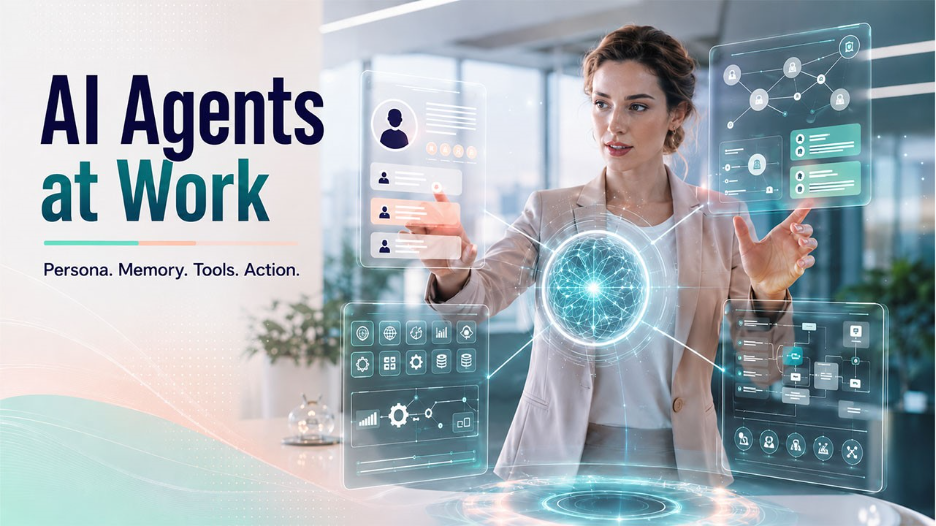
Each agent defines its role, personality, and style of communication, including description of available tools and particular instructions.
Persona:
A well-defined persona enables an agent to ensure a consistent character and work in a way that is relevant to the assigned role. It evolves as the agent gets more experience and interacts with its environment.
Memory:
The agent is well-equipped in general with long-term, short-term, and episodic memory. Short-term memory for instant interactions, long-term memory for historical data and interactions, episodic memory for prior interactions, and consensus memory for shared data among agents. The agent can ensure context, learn from past experiences, and enhance performance by recalling past interactions and adjusting to new situations.
Tools:
They are external resources and functions that an agent can leverage to interact with its environment and improve its capabilities. They enable agents to perform complicated tasks by accessing and modifying data or controlling external systems. They can be categorized as per the UI, including graphical, physical, and program-based interfaces. Tool learning involves training agents on how to effectively utilize these tools by understanding their context and functionalities in which they should be applied.
Model:
LLMs (Large Language Models) work as the foundation for developing AI agents, giving them the capability to understand, reason, and act. Leading LLMs such as Claude AI, Gemini, and GPT-5 serve as the brain of an agent, allowing them to process and create languages, while other agents ensure reason and action.
Read More: Small businesses can accelerate their operations and growth with the help of AI tools and agents. Check out our guide on Best AI tools for Small Businesses to understand what AI tools small businesses can use.
Conclusion
AI agents are transforming how software communicates with the world, executing actions, reaching goals, solving problems through reasoning, autonomous decision-making, and learning over time. From the ReAct framework to multi-agent orchestration, systems are developed on layered architectures that showcase smarter decision-making. As foundational models become increasingly capable, AI agents will manage growing complex tasks across distinct industries. Understanding how they work today can put you ahead of the curve and establish a rewarding career path in the AI-based workflows.
Read More: How AI Is Transforming Business Operations: A Complete Guide
Frequently Asked Questions :
1. What is an AI agent?
An AI agent refers to a software system that utilizes AI to complete tasks autonomously, make choices, and reach objectives on behalf of users.
What are the key features of an AI agent?
The core features are acting, reasoning, planning, observation, and self-refining, allowing agents to adapt and enhance over time.
3. What is the ReAct framework for AI agents?
ReAct (Reasoning and Acting) refers to a framework where an agent cycles through Thought, Action, and Observation until the final object is achieved.
4. How do AI agents utilize short-memory?
Agents leverage short-memory for present interactions, long-term memory for historical data, and episodic memory to recall previous interactions and enhance responses.
5. What is multi-agent orchestration?
t is a system where numerous specialized agents collaborate together, each having its own role and toolset, to manage complicated tasks more effectively than a single agent.