
Artificial intelligence has moved from a futuristic concept to a core part of how technology works today, powering everything from search engines to business automation. But despite how often the term comes up, many people still aren’t entirely clear on what AI actually is or how it works.
This guide breaks it down in simple terms. We’ll cover what artificial intelligence is, the different types of artificial intelligence, and how artificial intelligence works under the hood, from data collection to decision-making. We’ll also look at the relationship between AI, machine learning, and deep learning, explore generative AI and AI agents, and walk through real-world artificial intelligence examples across industries like healthcare, finance, and retail. By the end, you’ll have a clear, complete picture of what AI really is and why it matters.
What is Artificial Intelligence?
Artificial Intelligence (AI) refers to computer systems designed to perform tasks that typically require human intelligence, such as understanding language, recognizing patterns, solving problems, and making decisions.
Types of Artificial Intelligence
1. Based on Capabilities
- Narrow AI: Designed for one specific task like speech recognition or recommendations.
- General AI: A theoretical AI that thinks and performs across multiple domains like a human.
- Superintelligent AI: A hypothetical AI that surpasses human intelligence in reasoning and decision-making.
2. Based on Functionalities
- Reactive Machines: Responds only to current inputs with no ability to store or learn from past experiences.
- Limited Memory: Uses past data and observations to make smarter, more informed future decisions.
- Theory of Mind: A theoretical AI that could understand and interpret human emotions, beliefs, and intentions.
How Artificial Intelligence Works?
- Data Collection: It gathers large volume of data such as text, images or sensor reading to build foundation for learning.
- Processing and learning: It analyses data to identify key patterns and features to develop basic understanding.
- Model Training: Training AI model using the data by adjusting its internal settings for predictions. With more data, the model becomes more better and accurate.
- Decision Making: Applies learned patterns to make better real-world decision.
- Feedback and Improvement: Refines decision-making over time, continuously improving with every interaction.
Here’s something that surprises most people: Artificial Intelligence, Machine Learning, and Deep Learning are not three different things, one is actually born from another. They share a relationship that is layered, logical, and surprisingly elegant once you see it mapped out.
Take a look at how they fit together:
Machine Learning
Machine Learning can be thought of as an apprentice who is very good at recognizing patterns in structured data (e.g., spreadsheets, numeric, database), yet it still requires supervision from humans to formulate the rules to abide by.
How it works
In conventional ML, humans handle feature extraction themselves. For instance, to predict house prices, we must provide features like square footage, number of bedrooms, and ZIP codes manually. Then, the algorithm analyses these factors and assigns proper weights for its predictions. So, we do the hard part of figuring out what details matter, and the model learns from our inputs.
Advantages:
- No need for powerful supercomputers to implement it.
- Runs well even on laptops
- Fits small and cleaned datasets perfectly.
Disadvantages:
- There are limits to its capabilities.
- After some amount of information is fed to the machine, it becomes impossible to make it smarter.
- Human involvement is vital to prepare the data beforehand.
Deep Learning
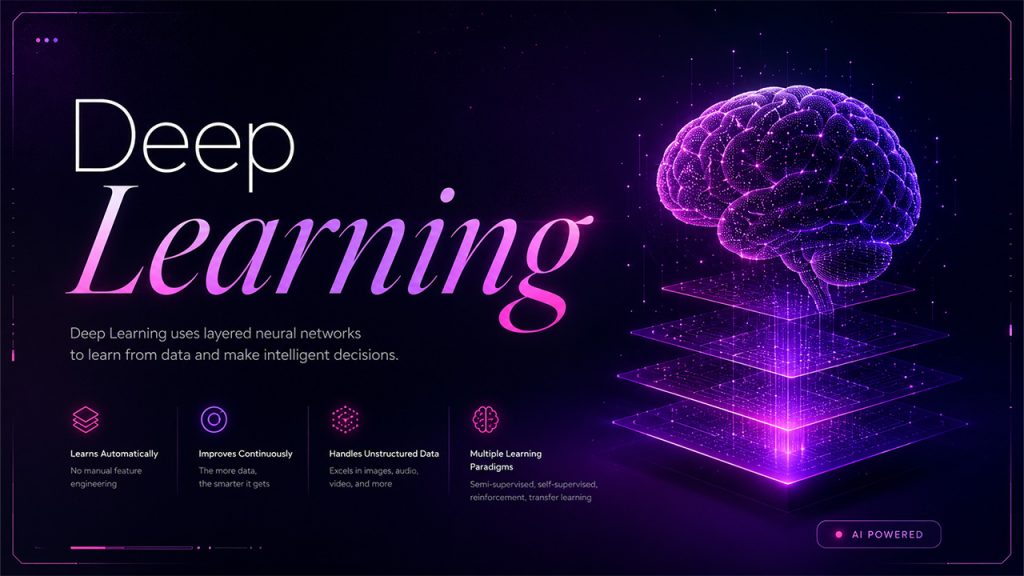
Deep Learning is a specialized branch within the domain of Machine Learning that uses advanced algorithms. Inspired by human anatomy, it uses layers of neurons (Artificial Neural Network) for information processing.
How it works
Unlike other methods, it doesn’t need human help for feature detection. Instead, it uses many layers of algorithms; each one improves the data and passes it onto the next layer. So, the data gets analysed and refined through this process automatically.
Deep Learning also enables:
- Semi-supervised Learning: Combines labelled and unlabelled data to train AI models, striking a balance between supervised and unsupervised learning.
- Self-supervised Learning: Generates its own labels from raw, unstructured data rather than relying on manually labelled datasets.
- Reinforcement Learning: Learns through trial and error, improving over time by receiving rewards for correct actions and penalties for wrong ones.
- Transfer Learning: Applies knowledge gained from one task or dataset to boost performance on a different but related task.
Advantages:
- There is nothing stopping it from improving.
- The more data you give a deep learning system, the better it gets.
- It is extremely efficient at working with unstructured data, such as raw audio, video, and images.
Disadvantages:
- Deep Learning needs an enormous amount of data and computing power.
- It is considered a black box, which means that engineers are unable to view the processes inside the artificial neural network.
Generative AI
Generative AI refers to artificial intelligence system that could create new content like text, image, video, code and more, by learning patterns from existing data.
How it works
Generative AI picks up the stats from its training data and spits out similar stuff. Transformers lead the pack right now, powering most big language models, so that’s mainly what we see today.
Key techniques include:
- Large Language Models (LLMs): It is trained on vast text corpora to predict and generate language. Examples: Claude, GPT-4, Gemini, Llama.
- Diffusion Models: It gradually denoise random data into coherent images or audio. Examples: Stable Diffusion, DALL·E, Sora.
- GANs (Generative Adversarial Networks): There are two networks that compete with each other, one that generates and other one discriminates. Mainly important for image synthesis.
- VAEs (Variational Autoencoders): It encode data into a compressed latent space, then decode it to generate variations.
From AI writing tools updates to image generators and code assistants, generative AI is rapidly expanding what creative and professional work looks like.
Advantages:
- It boosts productivity & saves time
- Makes creativity accessible to everyone
- It also speeds up innovation & research
Disadvantages:
- Enables misinformation & deepfakes, making it easy to create convincing fake content that erodes public trust and spreads false narratives.
- Prone to bias & hallucinations, often producing confidently incorrect outputs that can mislead users in critical situations.
- Risks displacing jobs at scale, threatening livelihoods in creative, technical, and service industries faster than workers can adapt.
AI Agents and Agentic AI
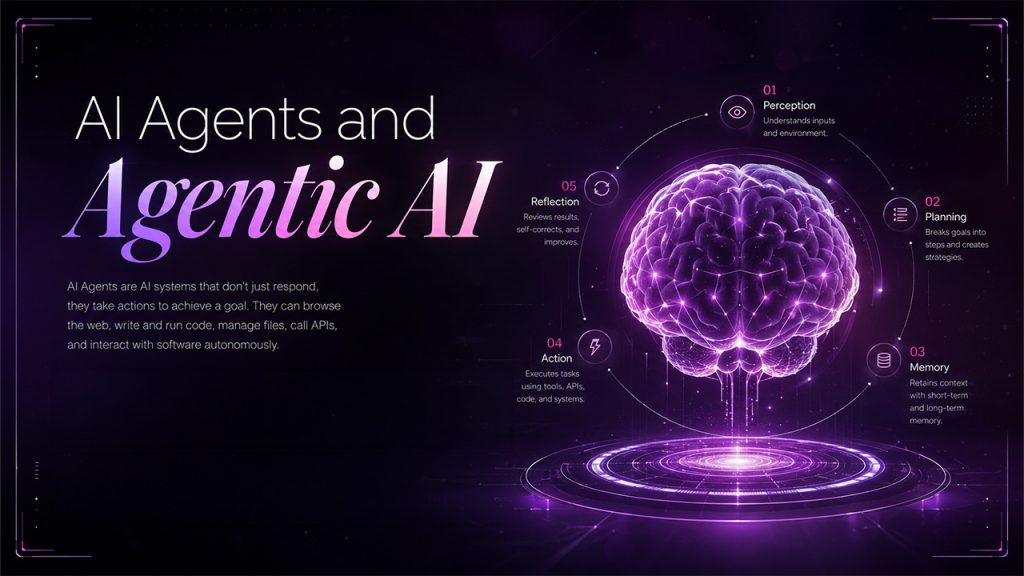
AI Agents are AI systems that don’t just respond, they take actions to achieve a goal. They can browse the web, write and run code, manage files, call APIs, and interact with software autonomously.
Agentic AI is the broader paradigm where AI operates with autonomy, memory, and multi-step planning rather than just answering a single prompt.
Traditional chatbots and AI models can only do so much because they follow set rules and need humans to step in when situations go beyond their limits. AI agents are different. They can break down a problem into steps and figure out how to tackle it, and adjust when situations change. The words “agent” and “agentic” come from the idea of agency, the ability to act independently, make decisions, and get things done without being told every step of the way.
How it works
- Perception: Takes inputs such as text, images, data, and tools to understand the environment and what is being asked of it.
- Planning: Breaks down complex goals into smaller, manageable sub-tasks and determines the best sequence of steps to achieve the desired outcome.
- Memory: Retains information through short-term memory (active context within a session) and long-term memory (stored databases) to maintain continuity across tasks.
- Action: Executes real-world operations by calling tools, hitting APIs, running code, or coordinating with other agents to move tasks forward.
- Reflection: Reviews its own outputs and actions, identifies errors or gaps, and self-corrects to improve accuracy and stay aligned with the original goal.
Benefits of AI
- Fewer human error: AI minimizes errors in data processing, analytics and other tasks through automation and algorithm that follow same task every single time.
- Automation: AI powers AI Workflow Automation by handling entire workflows independently, it makes team free from repetitive tasks like data collection and preprocessing, so they can focus on more meaningful, creative work.
- Fast and Accurate: AI can process vast amount of data more quickly than a person, it can discover patterns that someone might miss.
- Anytime accessibility: Unlike humans, AI never sleeps or loses focus, it runs around the clock, delivering consistent performance whether it’s handling customer support through chatbots or maintaining steady output on production lines.
- Fast and Accurate: AI processes vast amounts of data in seconds, discovering patterns and relationships that would take humans significantly longer to detect and with far greater accuracy.
Artificial Intelligence Example
- Healthcare: Used for early diagnosis and treatment recommendations using medical data.
- Retail: Applied for making shopping personalise and managing inventory efficiently.
- Costumer Services: Powers chatbots that provide 24/7 availability and support.
- Finance: Applied for fraud detection, risk analysis and investment support.
- Manufacturing: Predicts equipment maintenance needs and optimizes production processes to minimize downtime and boost output.
Challenges
- Data Risk: It depends on large amount of data to raise serious concerns around privacy protection and data security.
- Biasness: Biased training data can result in unfair decisions that affect real people.
- Lack of Transparency: The complexity of some AI models makes it difficult to understand how they arrive at decisions.
- Job Displacement: Automation can lead to job displacement, pushing the need for reskilling of workers.
- Ethical Concerns: Deploying AI in sensitive areas demands responsible development to prevent misuse.
Conclusion
Artificial Intelligence is no longer a distant concept. It is shaping the way we work, create, and make decisions every day. From machine learning and deep learning to generative AI and autonomous agents, each layer of AI brings us closer to a future that is smarter, faster, and more connected. Like every powerful technology, it comes with responsibilities. However, when understood and used correctly, AI is one of the most transformative tools humanity has ever built.
To stay updated on the latest in AI, including tools, trends, and breakthroughs, visit AiSuites and explore everything the world of artificial intelligence has to offer.
Frequently Asked Questions
What is Artificial Intelligence in simple terms?
Artificial Intelligence is technology that enables machines to think, learn, and perform tasks that normally require human intelligence, like recognizing speech, making decisions, or generating content.
What is the difference between AI, Machine Learning, and Deep Learning?
AI is the broadest concept, Machine Learning is a subset of AI that learns from data, and Deep Learning is a specialized subset of Machine Learning that uses neural networks to process complex data.
What are the main types of AI?
AI is categorized as follows:
- By capability:
- Narrow AI
- General AI
- Superintelligent AI
- By functionality
- Reactive Machines
- Limited Memory
- Theory of Mind
- Self-Aware AI.
What is the difference between AI Agents and regular AI?
Regular AI responds to single prompts, while AI Agents act autonomously — planning, executing, and self-correcting across multiple steps to achieve a broader goal.
How does Generative AI work?
Generative AI learns patterns from existing data and uses that knowledge to create new content like text, images, audio, and video through models like LLMs, Diffusion Models, and GANs.