

Introduction
More buyers nowadays rely on Gemini, ChatGPT, Perplexity, and other AI tools to know which brand to trust before they have even opened a search engine. When an AI platform answers a question regarding a service or a product, it depends on the inconsistent and scattered data from all around the web. The BrandRank.ai normalization transformation rules define the practical process of cleaning up the scattered brand data so AI platforms can identify a company as one clear and reliable entity instead of numerous confusing variations.
In this guide, let us break down what such rules essentially cover, why they are important for brand visibility in AI-generated responses, and how a business irrespective of the size can begin applying them.
What Are BrandRank.ai Normalization Transformation Rules?
At the heart of it, BrandRank.ai normalization transformation rules form a two-part process:
- Normalization makes distinct versions of similar facts consistent. For instance, mapping “BrandRank AI,” “Brand Rank,” and “brandrank.ai” to a single canonical brand name.
- Transformation transforms raw and unstructured data (a review, a paragraph, and an AI-generated answer) into organized fields a business can really measure, like sentiment, brand mentioned, topic, and citation source.
Now, it is imperative to be accurate here. BrandRank.AI is an actual AI visibility platform, created around the tagline “Prompting Your Brand Truth.” It keeps track of priority questions across different AI engines daily, scores brands based on visibility, readiness of content, and vulnerability, and is utilized by 60+ global brands. What the platform chooses not to publish is a single named technical document known as “normalization transformation rules.” The phrase is more effectively understood as an industry shorthand, which is a practical framework that SEO specialists, data teams, and brand managers utilize to describe the entity-resolution work behind any major AI visibility effort, including the kind BrandRank.AI performs.
Why Brand Data Consistency Ensures High AI Visibility?
AI platforms do not browse the web the way a person does. They create probabilistic models of what is brand and what it implies, as per how consistently such a brand shows across different sources. When the name of the company, name of the product, or location details vary from one page to another, the AI model gets less confident because it receives weaker signals about which facts it needs to trust.
This is exactly where normalization transformation rules become really valuable since they target the precise places where brand data tends to break down:
- Distinct punctuation, spelling, or casing of the brand name.
- Product names that move between press releases, marketing copy, and review websites.
- Inconsistent location or address formatting across different directories.
- Outdated names left over after an acquisition or rebranding.
- Duplicate listings on business directories and review platforms.
- Schema markup or structured data that does not match the visible content on the page.
Now, it is true that none of these guarantees an AI citation. Clean data just provides the AI model with a more corroborated and clearer picture to cite from instead of a set of confusing fragments.
Main Categories of Normalization and Transformation Rules
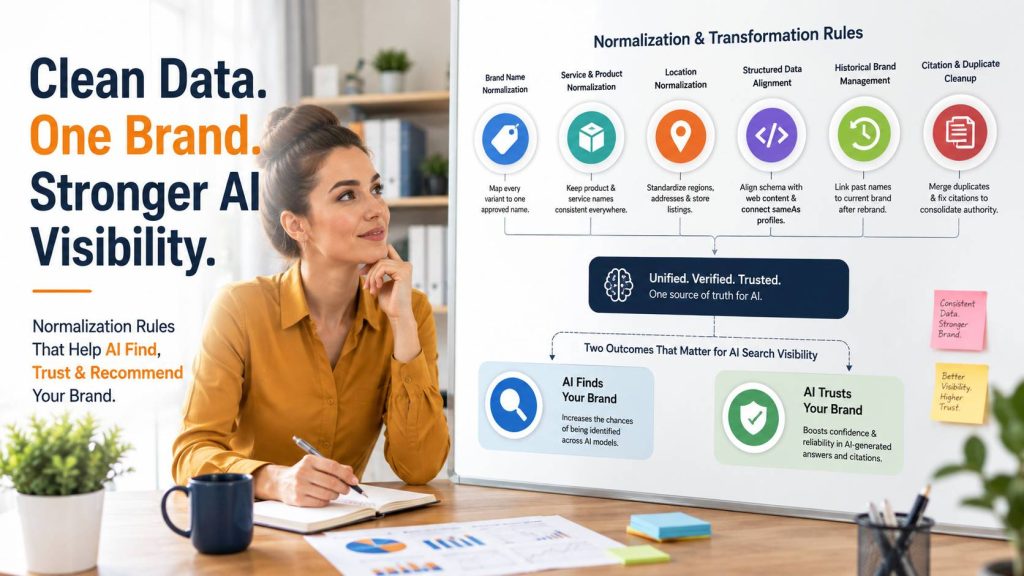
A possible rollout of BrandRank.ai normalization transformation rules generally touch upon a handful of recurring categories:
- Brand Name Normalization — mapping each variant of a name to a single canonical and approved form.
- Service and Product Name Normalization — Ensuring that the name of the product remains consistent across PR, marketing, and third-party reviews.
- Location Normalization — standardizing regions, addresses, and store listings into a single format.
- Organized Alignment of Data — Ensuring Product and Organization schema markup align with the visible page precisely, including the sameAs property connecting official social profiles.
- Historical Management of Brand — Linking former names to the present ones after a rebrand, which updates and redirect pages.
- Citation and Duplicate Cleanup — Correcting or merging repeated listings that divide authority across different records.
Every category gets fed into two outcomes that are important for AI search visibility: whether an AI model identifies the brand at all, and how confidently it considers the brand as a reliable source when creating an answer.
A Pragmatic Way to Apply These Rules
A business does not require a data engineering team to begin. A practical way is as follows:
- Audit the brand across its social profiles, websites, directories, and review platforms to find addresses, inconsistent names, and product labels.
- Create a Record of Canonical Brand — One reliable source of trust for the official product names, official name, and description.
- First Fix Owned Pages- This is because a business has total control over its own structured data and website.
- Fix Top-authority Third-party Listings- Emphasize pages that rank well already or often get cited.
- Include Precise Schema Markup that imitates what a visitor sees on the page.
- Test Actual Customer Queries across a few AI solutions and keep note of where the brand is outdated, missing, or misrepresented.
- Repeat the Audit every quarter because brand data as old pages stay, and new content gets published.
This is also where AI governance and content strategy join. Businesses that consider AI oversight already as a structural responsibility instead of being an afterthought, tends to have a simpler time making sure that the brand data remains clean, which is a point already covered in more depth in this piece on why AI transformation is fundamentally a governance problem.
Where Content Creation Fits In

Clean data does not make content citable alone. AI models prioritize writing that is clearly structured, dense with accurate factors. They tend to avoid citing overly promotional and vague marketing language. Thus, this clearly means that the actual drafting process is as important as core data hygiene. Teams drafting FAQs, blog posts, and product pages at scale often lean on AI writing platforms to ensure that the formatting as well as structure remains consistent across a scaling content library. This is a workflow shift, which is covered in detail in this overview of recent AI writing tool updates for content creation. Consistent formatting, combined with precise structured data, provides AI platforms with lesser reasons to ignore the own pages of the brand in favor of the third-party source.
Prevalent Mistakes You Need to Avoid
A few missteps repeatedly show up when businesses do this work on their own:
- Combining two similarly named but often unrelated businesses without checking location, domain, and product details.
- Considering each brand mentions as a citation, even when no link of source is there.
- Including schema markup that claims facts that are not visible on the actual page.
- Fixing the website but ignoring review platforms and third-party directories.
- Anticipating immediate outcomes, when AI visibility changes often show up over weeks or months.
Avoiding such errors makes sure that the normalization work remains accurate, which is more important than doing it fast.
Conclusion
BrandRank.ai normalization transformation rules explain a valuable discipline, even though the precise phrase is not published technical standards from the BrandRank.AI itself. Normalization generates one consistent version of the identity of the brand; the transformation converts unstructured and scattered mentions into fields a business can track and improve actually. For any company looking to accurately show up in Gemini, ChatGPT, or Perplexity responses, the beginning point is always the same: consistent naming across each channel, precise structured data, and repeatable process of audit. When it is consistently applied, such practices provide AI systems with a more trustworthy and clearer picture of a brand, which is the actual pillar of AI visibility.