A critical perspective on automation, quality, and the enduring value of human judgment
Every few months, a new headline declares that AI is coming for writers’ jobs, and every few months, writers push back just as hard. Neither side is entirely wrong, and neither is entirely right either. The real answer sits somewhere in the noise between the two, quieter than either argument, but far more useful to actually understand.
Where AI Actually Delivers
This discussion has been going on for some time. Are we seeing a takeover of writers by artificial intelligence, or is there a transformation of the work itself? The truth, if you look at it objectively, lies in the middle. But it is more important than all the heated discussions on both sides of the debate would let us think.
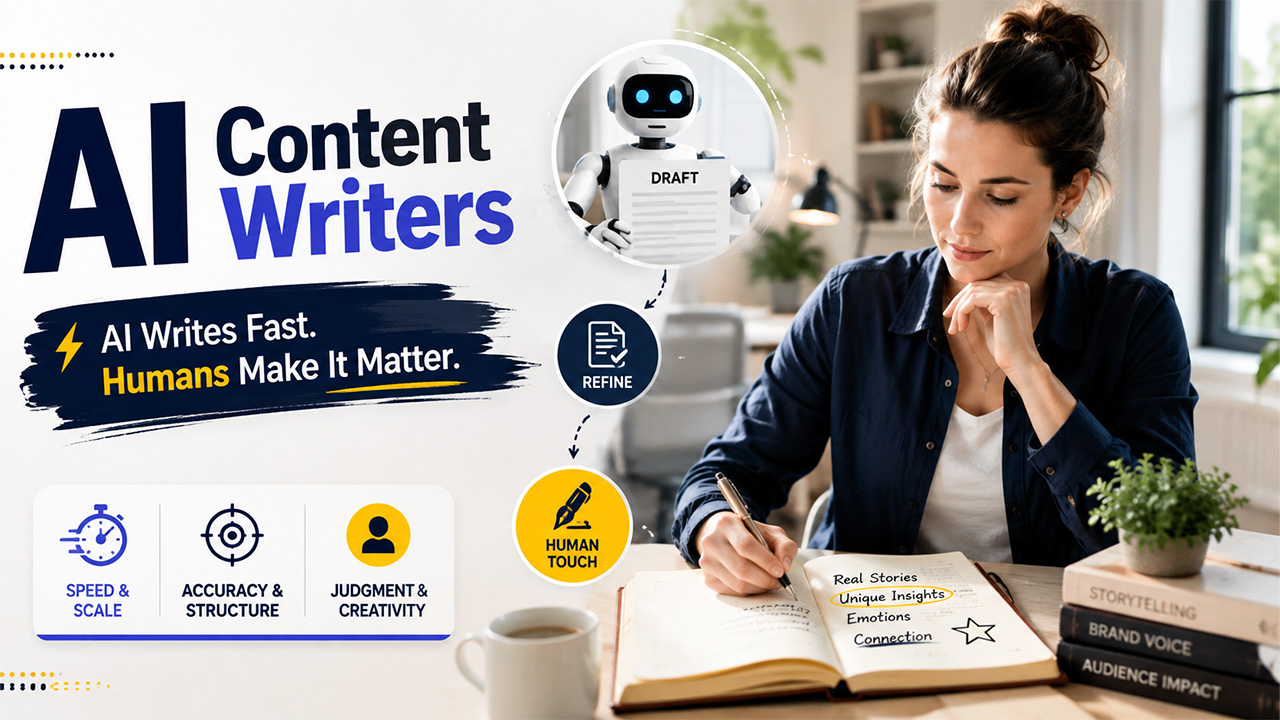
What does AI do? It can churn out an outline, put together a description for a product, or create an SEO outline more quickly than any team of humans. This is especially useful for AI business solutions generating large amounts of content. A clothing retailer with ten thousand pages to manage will certainly appreciate that. To deny it is nothing short of childish.
But speed and scale are not quality.
Where AI Falls Short
The problem is that AI does not understand context. It cannot comprehend the difference between something written for a 22-year-old audience and something written for senior management. It will not sense the vibe of the room. Yes, it can mimic the style, but it will not own it. Everyone who has ever edited AI writing knows that. There is something off about it. The sentences are perfect, but as a whole, the piece is like it was not written by anyone at all.
The Clearest Example : Journalism
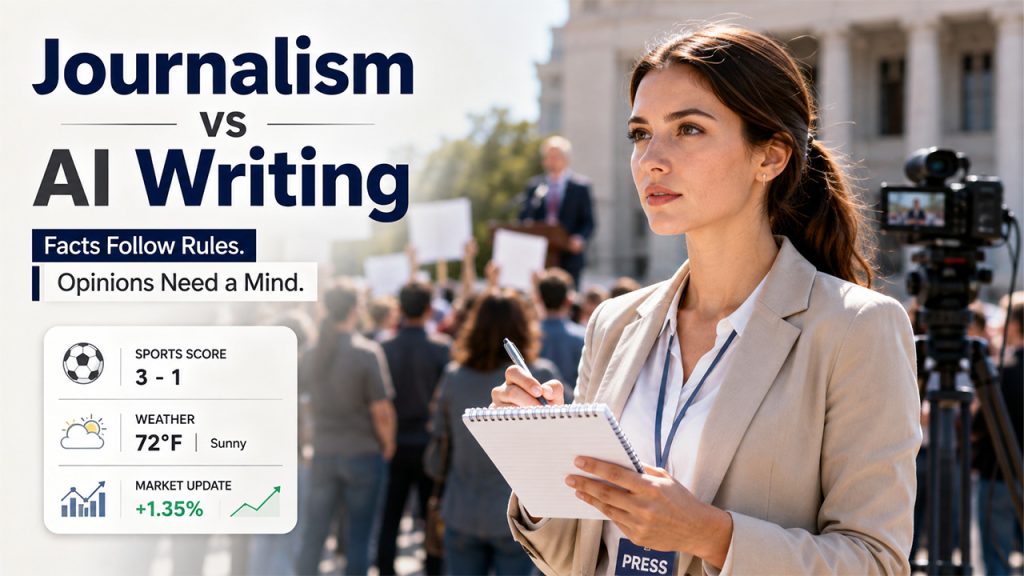
News stories make this point abundantly clear. Automatic writing can be used successfully for scores in sports, financial reports, or weather reports since there is a specific form the text should have, and there is a limited number of variables. However, ask an artificial intelligence to attend a rally, write an essay on cultural issues, or create an opinion piece that is going to argue its point effectively, and it will fail at the task most of the time. This is because such a piece requires the author to make a certain position clear and support it.
The Skills That Are Now More Valuable, Not Less
The actual skills journalists possess are now valued even more. They are definitely not becoming obsolete; on the contrary, the profession becomes more challenging than ever before. Journalists who know how to use AI writing tools, recognize its mistakes, and add necessary personal elements to the text are highly needed right now. Writing prompts are a skill. Revising automatically written text while maintaining its essence is a skill, and both of them cannot be automated.
Why Originality Still Wins
It’s important to note the angle of originality here. Google algorithms are already keeping up with the proliferation of thin AI content, and the public is fast following suit. Several companies have been quietly scaling back their reliance on automated content without editorial review after spotting declining engagement levels. This isn’t an accident.
Truth be told, the content creators that feel the pressure are primarily those who relied on formula anyway. The content that tells stories and speaks directly to the psyche of the reader? More interesting than ever.
Conclusion
None of this implies that artificial intelligence and human authors are competing for the same role. They do completely different roles, with one created to work fast and in large numbers while the other is created to think and reason. It’s not those authors who use AI who are going to have problems, but those who never learned how to express themselves well.
AI may have shifted the playing field, but it didn’t change what makes good content.
Frequently Asked Questions :
Will AI eventually replace content writers entirely?
Unlikely, at least not for writing that requires judgment, opinions, or emotions. AI will excel at structured and repetitive content but creating original content will continue to be tricky.
What kind of writing is most at risk from AI?
Low-effort, formulaic writing, boring product descriptions, cookie-cutter blog articles, and general SEO fillers are most vulnerable. Writing that involves a personality or an argument is not easily replicated by AI.
Should writers stop using AI tools altogether?
Certainly not. Content writing can be done much more efficiently with the help of AI. The danger does not lie in using AI, but in publishing what it creates.
How can a writer future-proof their career against AI?
They can do this by making use of what AI cannot duplicate: original reporting, opinion, voice, and editorial discretion. Those writers who can edit and guide the work of AI, not just generate it, are gaining value instead of losing it.
Does AI-generated content hurt SEO rankings?
Yes, it can, especially if it is not edited and reviewed before posting. Search engines have become quite adept at spotting low-quality AI-created content, and its engagement rate suffers.