
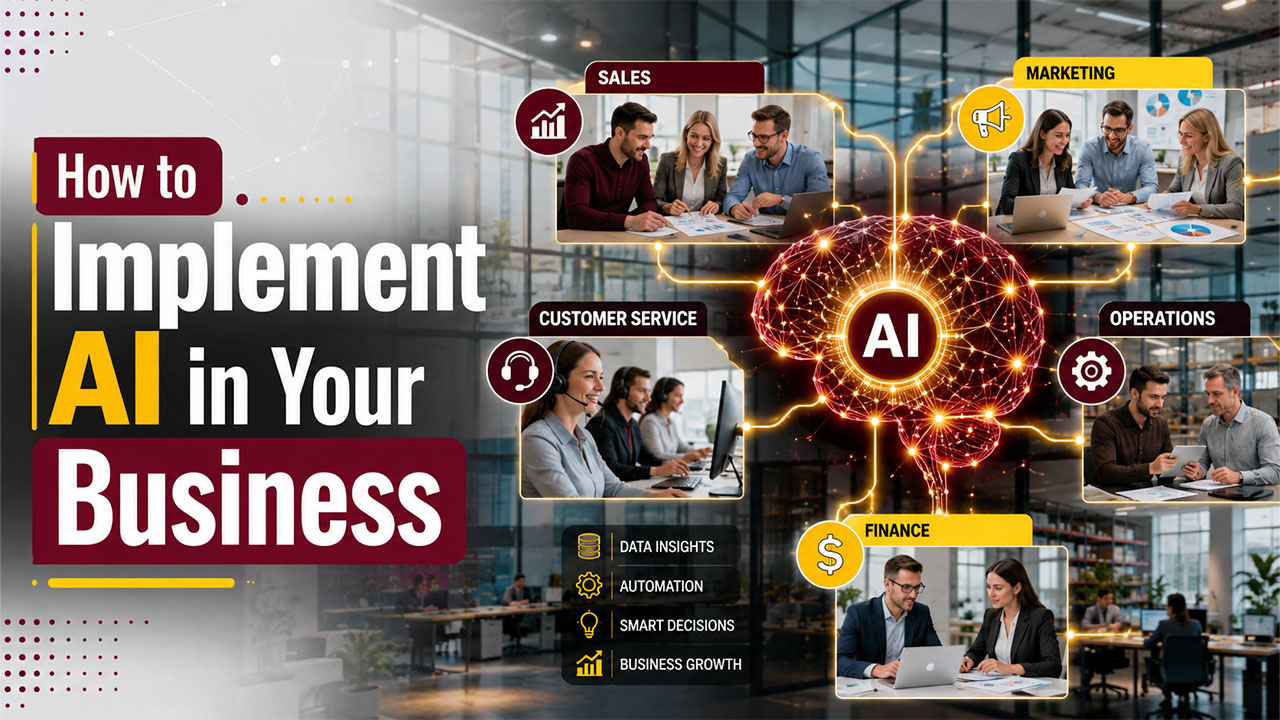
The article explores how to implement AI in your business, along with the benefits, common challenges, and best practices of implementing AI in your business.
In the current ever-evolving landscape, businesses of all sizes are using artificial intelligence (AI) mainly to improve efficiency, enhance customer experience, automate repetitive tasks, and make smarter decisions. From running a startup, an eCommerce store, a healthcare practice, or even a large enterprise, artificial intelligence has the potential to transform the complete workflow of the businesses.
However, successful implementation of AI requires more than simply adopting the latest technology. It involves identifying the right opportunities, along with preparing the organization for selecting the right AI solution and continuously optimizing performance.
What is AI in Business?
In business, artificial intelligence refers to the application of advanced technologies that enable software and machines to perform multiple tasks, which generally require human intelligence. The AI-based tools help in automating various tasks, such as analyzing data, recognizing patterns, understanding language, making predictions, automating repetitive processes, and supporting decision-making.
AI for businesses is designed to enhance the productivity of human employees, simply by handling routine and data-intensive tasks, which allows the team to focus more on strategic, creative, customer-centric work.
With the continuous development in AI technology, it has become more accessible to businesses of all sizes. From start-ups to large enterprises, organizations are utilizing AI to streamline operations, make data-driven decisions, and gain competitive advantages in digital marketplaces.
Benefits of Implementing AI in Business
Implementing AI in business offers various key benefits to organizations. By utilizing AI-powered tools and technologies, organizations can improve their efficiency, enhance customer experiences, and reduce operational costs. Implementing AI in business operations helps organizations streamline day-to-day processes, reduce manual workloads, improve resource allocation, and make faster, data-driven decisions across departments.
AI tools also help businesses in taking more informed decisions, as they can efficiently analyze large amounts of data and recognize patterns.
Some of the key benefits of implementing AI in business are as follows:
Increased Operational Efficiency :
AI-powered tools can seamlessly automate repetitive and time-consuming tasks, such as data entry, scheduling, invoice processing, and inventory management.
Enhanced Customer Experience :
The AI-powered tools, such as AI-powered chatbots and virtual assistants, can offer personalized customer interactions, along with answering queries 24/7 and offering tailored products and service suggestions. Businesses investing in AI customer service solutions can further improve response times, deliver personalized support around the clock, and enhance overall customer satisfaction while reducing support costs.
Better Decision Making :
The AI-powered tools can seamlessly analyze large volumes of data in real time, identifying patterns and trends, which may be difficult for humans to detect.
Improve Marketing Performance:
AI enables businesses to create targeted marketing campaigns by analyzing customer behavior, preferences, and purchasing patterns.
How to Implement AI in Your Business?
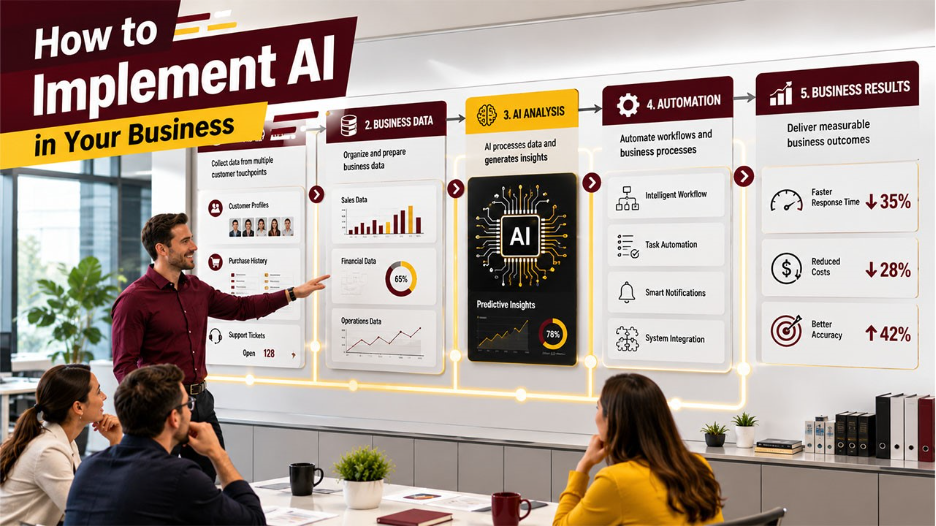
To understand how to implement AI in your business, users need to plan carefully, select the right technology, and have a clear understanding of the goals of the business. Rather than just adopting AI technology, businesses should focus more on solving real challenges and creating measurable value. A structured implementation strategy also helps in ensuring a smoother transition, along with maximizing ROI and encouraging long-term success.
The process of implementing AI in your business is as follows:
Identify Business Goal :
The first step in implementing AI in your business is determining what the business really wants to achieve with AI. Defining the business objective helps in selecting the right AI tool.
Evaluate Data Readiness :
The AI system relies heavily on high-quality data to deliver accurate insights and predictions. Before implementing AI, users need to review the data collected by businesses, which includes customer information, sales records, inventory data, financial reports, and website analytics.
Selecting the Right AI Solution :
Not every AI solution fits every type of business. Selecting the right tool, which addresses specific needs and integrates well with the existing software, is crucial. Businesses, depending on their objectives, may choose different solutions, such as AI-powered chatbots for customer support, predictive analytics for forecasting, and intelligent automation for repetitive tasks.Businesses implementing AI workflow automation can further streamline repetitive business processes, improve cross-department collaboration, and reduce operational bottlenecks while maintaining consistency across workflows.
Start with a Pilot Project :
Instead of deploying the AI solution across the entire organization, businesses should start with a small pilot project. Businesses can test AI in a single department or a specific process, which allows them to evaluate its effectiveness, identify potential challenges, and gather employee feedback.
Train the Employees :
A successful implementation of AI in your business largely depends on the adoption of the employees. Businesses need to provide training sessions, which can help teams in understanding how the AI platform works, how it supports their daily tasks, and how to use AI-powered tools effectively.
Integrate AI into Existing Workflows :
To maximize the efficiency of the AI platforms, businesses need to integrate the solutions with existing business systems, such as CRM software, accounting platforms, marketing automation tools, and project management applications.
Monitor Performance and Measure Results :
Implementing AI in your business is an ongoing process, rather than just a one-time project. Users need to continuously monitor key performance indicators (KPIs), which include productivity improvements, customer satisfaction, response times, and cost savings, among others.
Common Challenges in Implementing AI in Business
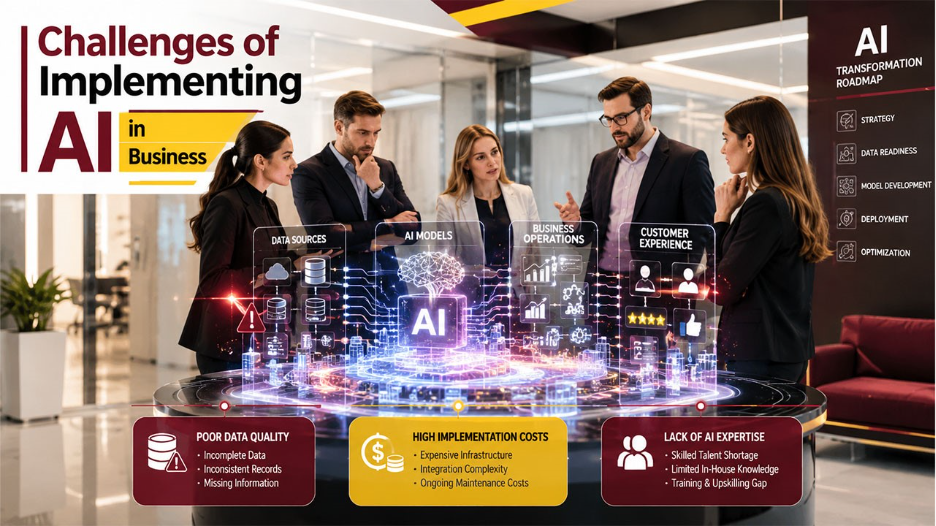
While implementing AI in your business offers key opportunities for innovation and growth, it also includes key challenges. Businesses often face various key technical, organizational, and financial challenges, which can slow the adoption of AI.
Some of the key challenges of implementing AI in your business are as follows:
- Poor Data Quality : The AI systems largely depend on high-quality data to generate accurate insights and predictions. Poor data quality, which includes incomplete, outdated, inconsistent, or inaccurate data, can generally lead to unreliable results, along with poor decision-making.
- Higher Implementation Costs : Although AI solutions are becoming more accessible, the process of implementing them with existing business systems requires significant investment. The implementation costs may include purchasing AI software, along with upgrading infrastructure, integrating systems, training employees, and maintaining AI models.
- Lack of AI Expertise : Businesses generally lack employees with advanced technical knowledge, which is needed to develop, implement, and manage AI systems. Hiring AI specialists or data scientists can be expensive, while existing teams may require additional training.
Best Practices for AI Implementation
Implementing AI in your business successfully requires more than just selecting the right technology. Businesses need a clear strategy, along with high-quality data, employee support, and continuous improvement.
Some of the proven best practices for successfully implementing AI in your business are as follows:
- Invest in High-Quality Data : AI systems rely heavily on accurate, consistent, and relevant data to produce reliable outcomes. Before deploying AI, users need to clean and organize data by removing duplicates, correcting errors, and standardizing formats.
- Train and Engage Employees : For successful implementation of AI in your business, employee adoption is essential. The team needs to understand how the AI tool works, how it benefits their daily tasks, and how to use AI-powered tools effectively.
- Integrate AI into Existing Workflow : Businesses should integrate AI with existing software and workflows, mainly to create a seamless user experience.
- Maintain Human Oversight : While AI can automate multiple tasks and offer valuable insights, it is also essential to involve human judgement for important business decisions.
Key Industries Using AI
Artificial intelligence is significantly transforming various industries across the globe by offering automated processes, improving decision-making, enhancing customer experience, and driving innovation. Businesses across multiple industries are adopting AI to increase their efficiency, along with reducing costs and gaining a competitive advantage.
Some of the popular industries utilizing AI are as follows:
Healthcare :
In the healthcare industry, AI-powered tools help improve patient care, streamline administrative tasks, and support medical professionals in making accurate diagnoses. It also helps in analyzing medical images, predicting disease risks, and assisting drug delivery.
Finance and Banking :
The finance and banking institutions utilize AI in enhancing security, improving customer service, and automating financial processes. The AI-powered tools help in detecting fraudulent transactions, assessing credit risks, automating loan approvals, and providing personalized financial advice to the clients.
Retail and E-Commerce :
The retail and e-commerce industries use AI to create a personalized shopping experience for the customer, along with optimizing inventory management and improving sales performance. AI-powered tools can also analyze customer behavior, along with recommending products based on purchase history, forecast demand, and automate customer support through virtual assistants and chatbots.
Manufacturing :
In the manufacturing sector, artificial intelligence helps in improving quality control and reducing operational costs. AI tools can also predict maintenance, along with identifying equipment issues, minimizing production downtime.
Marketing and Advertising :
In marketing and advertising, AI has grown as a crucial component, which is used to analyze customer data, segment audiences, automate email campaigns, optimize digital advertising, and generate personalized content.
Conclusion
Implementation of AI in businesses is no longer considered a futuristic concept, but it is a crucial step in the present day, which helps organizations stay competitive in the rapidly evolving digital landscape. Implementing AI in your business offers various key benefits to organizations, such as improving efficiency, enhancing customer experiences, enabling smarter decision-making, and automating repetitive tasks. Organizations that adopt AI are also better positioned to innovate, scale, and deliver higher value to their customers. In the modern digital ecosystem, AI is not just a technological upgrade, but it acts as a transformative force that can significantly reduce how businesses operate.
Frequently Asked Question :
Can AI help small businesses?
Yes, AI can help small businesses in automating tasks, improving marketing, enhancing customer management, and making data-driven decisions with limited resources.
Do I need any technical expertise to implement AI in my business?
No, having technical expertise can be helpful, but many AI tools are user-friendly.
What are some key examples of AI tools in businesses?
Some key examples of AI tools in business include chatbots, recommendation systems, predictive analytics, fraud detection, and marketing automation.
How long does it take to implement AI in a business?
Implementation of AI in a business generally depends on the complexity of the tool. A simple AI tool can be implemented in weeks, while larger systems may take months for complete implementation.