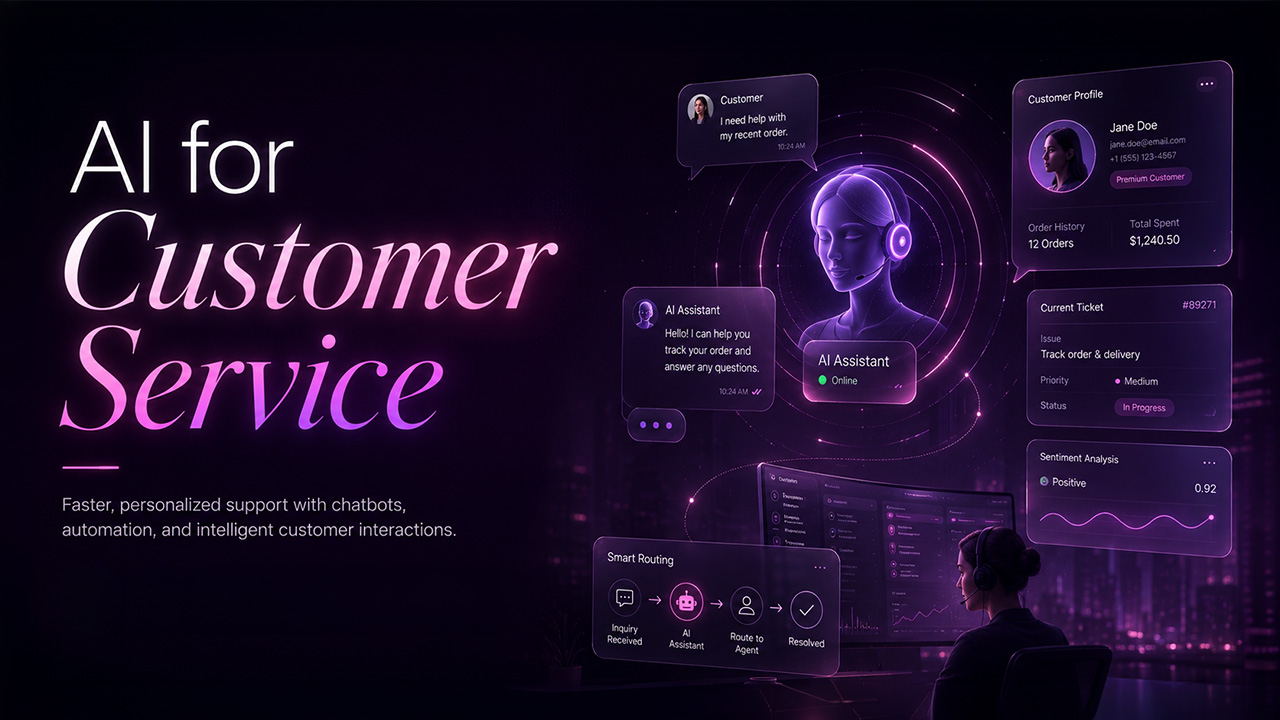
Think about the last time you reached out to a company for help. Maybe you were stuck with a billing issue at 11 PM. Maybe your order went missing and you needed answers before the weekend. You did not want to wait on hold for thirty minutes. You did not want to explain your problem three times to three different people. You just wanted someone or something to actually help. It is what millions of customers feel every single day. And honestly, it is also what support teams feel from the other side: too many queries, not enough hours, and expectations that just keep climbing. Things needed to change, and AI Customer Service brings that change.
But here is what most people get wrong about it. The companies genuinely winning with AI are not using it to replace people. They are using it to make every single interaction feel sharper, faster, and more considered. And that is the version of AI worth
talking about.
What Is AI in Customer Service?
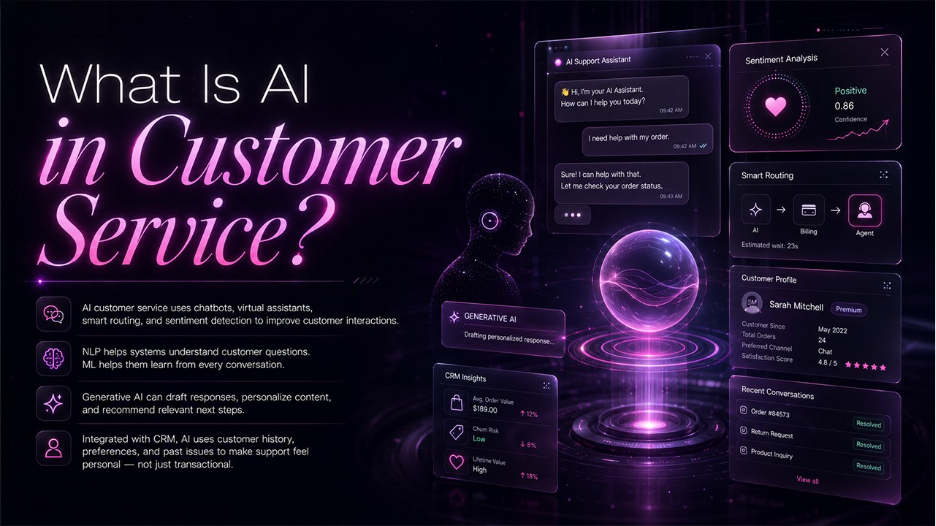
AI customer service refers to the use of artificial intelligence such as chatbots, virtual assistants, smart routing, and sentiment detection to handle, improve, or support customer interactions. These systems use natural language processing (NLP) which allows them to understand what people are asking in their native language. Additionally. Machine learning (ML) helps them improve over time. They learn with every conversation to produce better results the next time someone asks something.
Generative AI has pushed things further still. It does not just answer pre-set questions anymore. It can draft responses, create content tailored to a specific customer, and make suggestions that feel genuinely relevant rather than copy-pasted from a script.
When you integrate AI into CRM, it becomes even more useful. The AI can find a customer’s history, their preferences, past issues, interactions, and leverage them to make customer support feel more personal rather than just transactional.
Key Benefits of AI Customer Service
From automating workflows to enhancing customer experiences, AI is transforming business operations in ways that touch speed, cost, quality, and consistency all at the same time.
Faster Response Times: AI replies instantly. There is no queue, hold music, or wait. Customers get answers the moment they ask or say something.
24/7 Customer Support Availability: AI is never on holiday. You can get support at midnight, on weekends, public holidays, and whenever someone actually needs it.
Lower Operational Costs: Automating routine queries means you do not need to keep growing your team every time request volumes go up.
Personalized Customer Experience: AI leverages customer data and their past behavior to offer solutions that are actually relevant. It does not give a generic answer but something that is specific to that person.
Improved Agent Productivity: When AI takes care of the repetitive stuff, human agents are free to focus their energy on the complex and emotionally sensitive cases that genuinely need a human touch. Research from the National Bureau of Economic Research found that agents working with AI tools saw an average productivity boost of 14%.
AI-PoweredSentiment Analysis: AI can recognize the emotional tone in a customer’s message. Whether it is frustration, confusion, or urgency; it catches these signals and helps teams respond with the right level of care.
Consistent Omnichannel Support: It provides omnichannel support whether a customer reaches out on chat, email, phone, or social media; AI keeps the experience coherent. AI handles the surge without compromising service quality.
Actionable Customer Insights: Every conversation generates data. AI collects and analyzes data, to identify patterns, recurring pain points, and preferences that help businesses make smarter decisions to improve customer experience.
Top AI Customer Service Examples and Applications
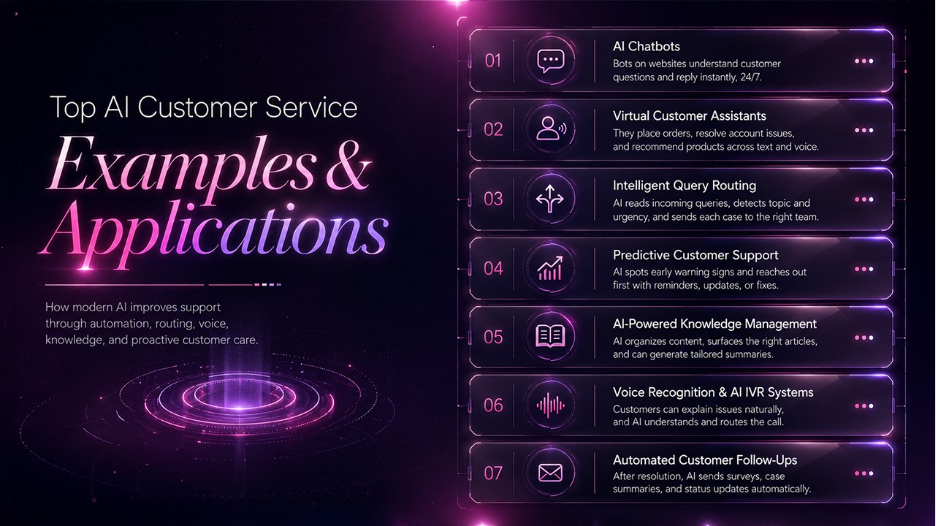
AI shows up in several different forms depending on where and how a business uses it.
AI Chatbots: Have you noticed a chat box that pops up when you visit a website? That is usually a bot. It picks up your question, understands what you mean, and responds immediately at any time of day.
Virtual Customer Assistants: They can place orders, resolve account issues, and give product recommendations. They work across both text and voice, and they feel more like a capable assistant than a glorified FAQ page.
Intelligent Query Routing: It is the quiet one that most customers never notice. AI reads an incoming query, figures out the topic and urgency, and sends it to exactly the right person or team. There are no transfers or passes around. It just lands in the right place.
Predictive Customer Support: Instead of waiting for a complaint, AI identifies early signals and reaches out first. It gives a heads-up, a reminder, or a fix before the customer even realizes something is off.
AI-Powered Knowledge Management: It keeps content organized and easy to find. AI tags and surfaces the right articles for both customers and agents. Some systems use generative AI to create instant, tailored summaries rather than directing someone to a long document they have to read through.
Voice Recognition and AI IVR Systems: Customers can describe their issue naturally instead of pressing through a ten-step phone menu. The AI understands plain language and routes from there.
Automated Customer Follow-Ups: AI closes the window without any manual effort in the form of a satisfaction survey, a case summary, or a status update that is sent automatically once a query is resolved.
Use Cases Across Industries
See how businesses across different industries are applying AI customer service to improve support experiences, streamline operations, and meet growing customer expectations.
| Industry | AI Use Case | Impact |
| Retail & E-commerce | Chatbots for order tracking, returns, and product recommendations | Faster resolution, higher customer satisfaction |
| Banking & Finance | Fraud alerts and smart handling of account queries | Proactive support, fewer escalations |
| Healthcare | Appointment scheduling and symptom triage via virtual assistants | 24/7 access, reduced wait times |
| Telecom | Automated billing support and intelligent call routing | Lower call volumes, better first-contact resolution |
| SaaS / Technology | In-app support, self-service tools, and smart knowledge bases | Reduced ticket load, faster onboarding |
| Travel & Hospitality | Booking changes and real-time updates via conversational AI | Smoother experience during disruptions |
Conclusion
AI customer service is not about replacing people or slashing support budgets. It is about building something that actually works for customers who want real help on time and for teams who want to give it without burning out. AI delivers speed, personalization, and availability. But what makes customer service genuinely good is still the human layer that is empathy, judgment and the ability to tell when someone needs more than just an answer.
The future is not AI instead of people. It is AI alongside people, working in a way customers barely have to think about. That is the version worth building.
Frequently Asked Questions
What is AI customer service?
It is the use of artificial intelligence tools like chatbots, virtual assistants, and automation to support and improve customer interactions.
Does AI replace human support agents?
No. It handles routine tasks, so agents can focus on complex, high-value conversations that genuinely need a person.
What is sentiment analysis in customer service?
It is an AI feature that reads the emotional tone in a customer’s message so teams can respond with the right level of care and urgency.
Is AI customer service available around the clock?
Yes. Unlike human teams, AI tools run continuously without downtime or off-hours.
How does AI make support more personal?
By analyzing a customer’s history, behavior, and preferences, AI tailors its responses instead of giving the same generic answer to everyone.