Customer service has always been one of the most challenging areas of business operations. The high volume of inquiries, repetitive questions, long waiting times, and the necessity to constantly make sure customers are satisfied all add up to an extremely heavy load on the support team.
This is where the application of artificial intelligence (AI) in customer support comes into play. Instead of handling every customer contact personally, the company uses the potential of artificial intelligence technology to automate regular questions, reduce waiting times, and free up the time of employees for more complex communications.
In this guide, you will learn about AI customer service, its functioning, applications, benefits, limitations, and how to choose the best tool for your company.
What is AI Customer Service?
AI customer service entails the application of AI technologies such as natural language processing and machine learning to support customer interactions. These tools help businesses respond to inquiries and improve their support experiences, though not necessarily as a replacement for human agents.
The main objective is to use technologies like NLP, machine learning, and automation to route, interpret, and resolve customer queries as efficiently as possible.
An AI customer support system is applied differently in various businesses. An example is an automated FAQ chatbot used to address simple queries on websites, while others involve AI-assisted live chats where relevant data is provided for live support agents. Other examples include the provision of information to support agents during phone conversations and the logging of interaction data after calls.
How AI Works in Customer Service Workflows
Understanding how AI fits into a support workflow explains why it’s become so beneficial for businesses of all sizes, not just large corporations.
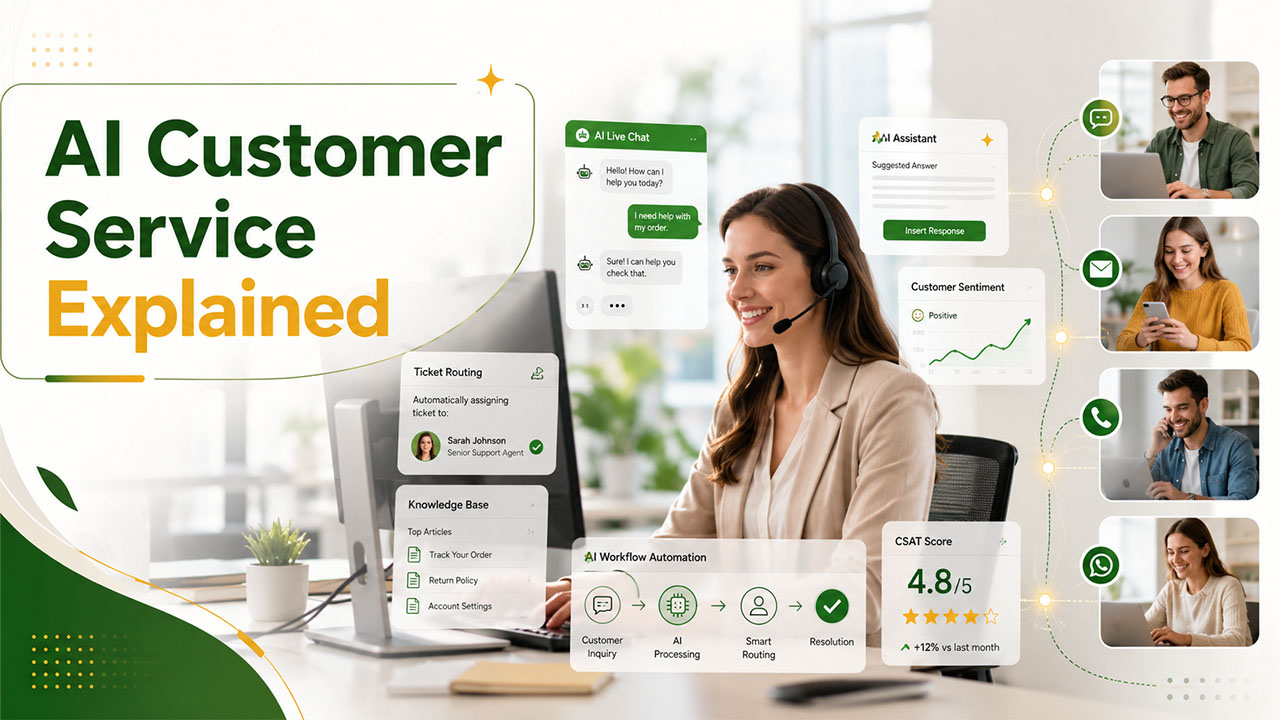
To begin with, at the front-end level, AI solves the problem of first-contact recognition. When customers start to use the channel, whether it is a chat, email, or voice contact, the AI solution will immediately recognize the request type and classify it and then resolve it or direct it to a specific department or agent without additional sorting efforts. This is the first step in saving much time.
Next, during the live interaction, the AI continues to operate backstage. In case when there is a need for a human agent to deal with a complicated issue, AI provides suggestions of knowledge base articles, possible responses, customer history, and so on. The support process becomes much faster thanks to this kind of help.
Finally, even after the conversation is over, AI handles summarizing, updating records, and tagging issues for reporting.
Key Use Cases of AI in Customer Support
AI-based customer support is much more prevalent than most people think. Here is a list of the most popular uses for AI technologies in customer support:
Chatbots and virtual assistants :
Respond to inquiries about orders, account data, or FAQs right away without the need for any human support to become involved.
Automated ticket routing :
Directs and sorts of incoming customer support tickets based on their topic, urgency, or other characteristics.
Agent assists tools :
Provide agents with automatic tips on how to respond to the client in real-time, along with other helpful information.
Sentiment analysis :
Detects emotions or tone in which the customer writes their support request, thus allowing you to spot angry clients in a blink.
Self-service portals :
Customer support portals where AI helps customers find the answer to their question by themselves.Together, these use cases show how AI-powered customer service can touch almost every part of the support journey, from the first message to the final resolution.
Benefits of AI-Powered Customer Service
The reasons businesses are investing in AI customer service go well beyond just cutting costs. The impact tends to show up across multiple areas at once.
Faster response times :
AI answers all routine questions immediately, reducing wait times that would otherwise frustrate customers and push them toward competitors.
Availability 24/7 :
Unlike human agents, AI is available around the clock. Thus, users will receive their answers regardless of the time of day without the business needing to employ workers around the clock.
Consistency :
AI provides consistent quality of responses every single time, which prevents variability in customer support due to the differences between various agents.
Less pressure on customer support employees :
As AI answers all the routine questions, employees will not have to deal with these kinds of queries but rather engage in meaningful conversations.
Scalability :
AI provides businesses with instant scalability when needed, especially during busy times and volume spikes, without employing new staff.
AI-powered customer service isn’t just about doing things faster; it’s about doing them more consistently, at scale, without sacrificing the quality customers expect.
Common Misconceptions About AI in Customer Service
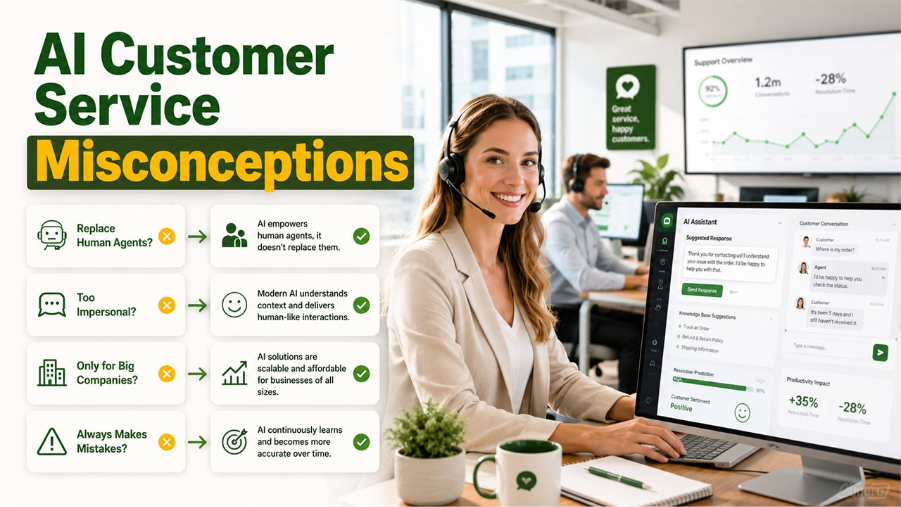
Although artificial intelligence customer service is becoming increasingly popular across industries, some stubborn myths prevent companies from making full use of it.
AI will replace human agents entirely :
AI handles high volumes of routine inquiries efficiently, but for complex and emotionally charged cases, the involvement of a person is necessary. Most organizations introduce AI to empower their representatives, rather than to get rid of them.
AI customer support feels cold and impersonal :
It is true about the first-generation chatbots, but contemporary artificial intelligence customer services are advanced enough to understand the context and interact much better with customers.
AI is only for large enterprises :
There are many AI solutions for small businesses that are both effective and cost-efficient.
AI always gets it wrong :
This may be true about old systems, but modern AI technologies are constantly trained on big data sets and have become much more efficient.
How to Evaluate AI Customer Service Tools
With so many tools available on the market, knowing what to look for can save a lot of time.
Define Your Use Case First :
Clarify the goal that needs to be achieved at the very beginning of the evaluation. The business dealing with simple requests will have a totally different need from the one with complex, multi-touch customer support procedures.
Check Integration and Automation Compatibility :
The best AI customer support software fits perfectly into your current business process without requiring any significant changes to your technology stack. Look for smooth connections with your CRM, helpdesk, and communication platforms, since this is also where AI workflow automation tools become relevant for linking customer service AI with wider business processes.
Think About Scalability and Long-Term Fit :
The best tool for now should work great for your business tomorrow too. Consider AISuites type software products for future scalability and avoid switching to another tool for the second time in the future.
The right tool should feel like it’s working with your team, not adding friction to an already busy support operation.
Challenges of AI Customer Service
As promising as AI customer service is, it comes with its own set of hurdles that businesses need to plan for before diving in.
- Handling complex or emotional interactions : AI still struggles with nuanced, sensitive conversations that require genuine empathy and human judgment, making escalation to human agents essential.
- Data quality and training : AI systems are only as good as the data they’re trained on, so poor or inconsistent data leads to inaccurate responses and frustrated customers.
- Customer resistance : Some customers simply prefer talking to a human and many disengage entirely if they feel they’re only getting automated responses.
- Ongoing maintenance : AI models need regular updates and monitoring to stay accurate as customer needs, language, and business processes evolve over time.
- Security and data privacy : Handling customer data through AI systems introduces compliance considerations that need to be carefully managed, especially in regulated industries.
None of these are deal-breakers, but going in with a clear plan for each one makes the difference between an AI rollout that delivers results and one that creates more problems than it solves.
Best Practices for Implementing AI Customer Service
Successfully adopting AI customer service requires more than simply deploying a chatbot. Businesses should follow a strategic approach to maximize efficiency while maintaining a positive customer experience.
- Start with repetitive tasks : Automate FAQs, order tracking, appointment scheduling, and ticket routing before expanding AI into more complex interactions.
- Keep human agents available : Allow customers to easily switch to a live representative whenever AI cannot resolve an issue.
- Train AI with quality data : Accurate knowledge bases and updated customer information help AI provide reliable responses.
- Monitor AI performance : Regularly review conversations, customer satisfaction scores, and resolution rates to identify areas for improvement.
- Continuously optimize workflows : As customer expectations evolve, businesses should refine automation strategies and update AI models to improve accuracy.
If you’re planning to adopt AI across your organization, our guide on How to Implement AI explains the complete process of selecting tools, preparing data, and integrating AI into everyday business operations.
Future Trends of AI Customer Service
Artificial intelligence continues to evolve rapidly, making customer support more intelligent and personalized. Businesses that stay ahead of these developments can deliver better customer experiences while reducing operational costs.
Some emerging trends include:
- Generative AI-powered support agents.
- Voice AI for phone support.
- Predictive customer service using behavioral analytics.
- Hyper-personalized customer interactions.
- AI-powered multilingual support.
- Autonomous AI agents capable of handling complete support workflows.
Keeping up with the latest AI Trends helps businesses understand how customer expectations are changing and which technologies will shape the future of support.
Conclusion
AI customer service has moved well past being a novelty, it’s now a practical, proven part of how modern businesses handle support at scale. From chatbots resolving routine queries instantly to AI assisting live agents in real time, the technology has matured to a point where businesses of almost any size can put it to work meaningfully.
We’ve covered what AI customer support is, how it fits into real workflows, where it’s being used, and the genuine benefits it brings, alongside the misconceptions worth dropping and the challenges worth planning for. The through-line across all of it is the same: AI works best not as a replacement for human support, but as a layer that makes the whole operation faster, more consistent, and easier to scale.
For businesses still on the fence, the question isn’t really whether to adopt AI-powered customer service anymore, it’s more about finding the right tools, starting with the right use cases, and building from there.
Frequently Asked Questions :
Q. What is AI customer service?
AI customer service refers to the use of artificial intelligence technologies like natural language processing and machine learning to handle, assist, or enhance customer support interactions across different channels.
Q. Will AI replaces human customer service agents?
Not entirely. AI handles routine, high-volume queries well, but complex and emotionally sensitive conversations still need a human agent. Most businesses use AI to support their teams, not replace them.
Q. What are the main benefits of AI-powered customer service?
The key benefits include faster response times, 24/7 availability, consistent quality, reduced agent workload, and the ability to scale support without proportionally increasing headcount.
Q. Is AI customer support suitable for small businesses?
Yes, there are plenty of scalable, affordable AI customer support tools designed specifically for smaller businesses that want meaningful results without enterprise-level budgets.
Q. What should businesses look for when choosing an AI customer service tool?
Start by defining your specific use case, then evaluate tools based on integration capability, ease of setup, scalability, and how well they connect with your existing CRM and helpdesk systems.