

Skillful writing takes patience, time, and constant refinement. Irrespective of whether it is a blog post, a business email, or a college assignment, getting the grammar, tone, and structure right can be complex. This is exactly where AI writing assistant proves to be crucial. It works as a digital writing assistant that assists you in drafting, editing, and polishing content in a fraction of the time it would take normally.
An AI writing assistant can no longer be considered a niche tool only used by tech-savvy professionals. Today, students, marketers, casual writers, and business owners alike depend on it to create coherent, clean, and well-organized content. From resolving grammatical mistakes to suggesting more effective phrasing, it is a valuable tool for anyone who regularly writes. As digital publishing and remote work continue to grow, the demand for fast, reliable, and accurate writing support has only elevated, making these tools a standard part of numerous professional workflows.
What is an AI Writing Assistant?
An AI writing assistant refers to a tool powered by natural language processing and artificial intelligence that aid users to create, edit, and enhance the written content. It assesses text for grammatical correctness, tone, clarity, and structure, then provides a real-time assistance to make sure that the writing becomes more effective.
Contrary to conventional spell-checkers, a modern AI writing tool goes deeper than offering surface-level corrections. It can:
- Recreate the sentences completely for higher clarity.
- Ensure tone adjustment to align with the intended audience.
- Ensure better vocabulary.
- Find repetitive phrases.
- Create content drafts or outlines.
Such capabilities ensure that AI content writing assistant becomes valuable across different industries, including education, marketing, publishing, and corporate communication. Different platforms also incorporate browsers, word processors, and email clients, enabling writers to get suggestions without switching between distinct applications. This smooth integration is one of the many reasons these tools have received broad adoption in recent times.
Why Use an AI Writing Assistant?
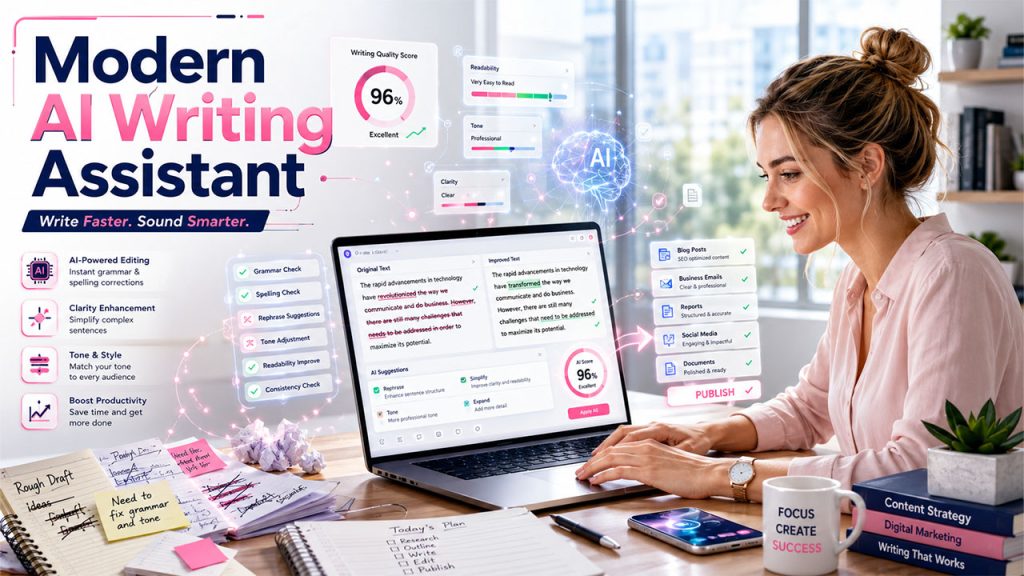
Writing is a one-step process rarely. It involves drafting, editing, reviewing, and proofreading. An AI writing assistant streamlines each of these stages by providing immediate feedback and suggestions.
Let us see a few reasons that students and professionals choose to utilize one:
- Saves Time: Automates routine editing tasks like punctuation checks and grammar.
- Enhances accuracy: Minimizes grammatical errors and spelling before publishing is done.
- Improves clarity: Offers simpler alternatives for complicated sentences.
- Provides Support to Consistency: Ensures a uniform style and tone across documents.
- Enhances productivity: Enables writers to finish tasks quickly without sacrificing quality.
For businesses creating huge volumes of content, a smart writing assistant can be specifically valuable. It makes sure that each piece, whether an email, blog, or report, ensures professional standards without needing numerous rounds of manual editing. Teams that frequently publish generally find that such tools minimize the back-and-forth communication needed between editors and writers, enabling content to go through review cycles more efficiently.
Key Features to Look for in an AI Writing Assistant
Not all platforms provide a similar level of advancement. When assessing an AI writing assistant, it is useful to look for specific core features that impact writing quality and efficiency directly.
1. Spelling and Grammar Correct :
A dependable AI grammar checker must catch not only typos but also the contextual errors, like incorrect usage of word or subject-verb disagreement.
2. Tone and Style Adjustment :
Good writing relies on aligning the tone with context. A capable AI editing tool empowers users to go between casual, formal, or persuasive tone as per the audience. Platforms such as Claude have created a good reputation for managing tone shifts effectively; go through our guide Claude AI explained to learn more.
3. Detecting Plagiarism :
For professional and academic writing, originality is important. A lot of AI writing platforms involve plagiarism checks to make sure that the content has authenticity before publication or submission.
4. Content Generation Support :
A few sophisticated AI writing software can create headlines, outlines, or even complete drafts as per the prompts, which is specifically valuable for content creators working under close deadlines. Choosing between different platforms generally boils down to personal workflow. We have explored a side-by-side comparison Claude vs ChatGPT that helps writers to decide which assistant aligns with their requirements better.
5. Multi-Language Support :
For international teams, an AI writing assistant with multilingual capabilities can ensure total consistency across distinct regions and also among non-native speakers.
6. Readability Scoring :
A few tools also assess how simply a piece of writing can be understood by the target audience, providing a readability score along with suggestions for explaining dense or technical concepts in simple language.
Who Benefits Most from an AI Writing Assistant?
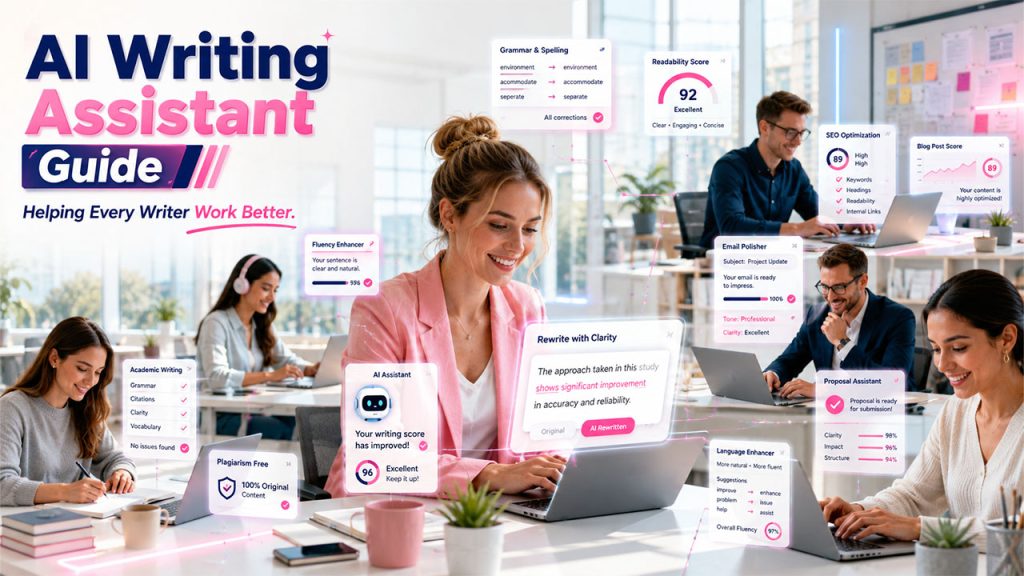
The flexibility of an AI writing assistant makes it valuable across different professionals and use cases:
- Marketers and Content Writers use it to expedite drafting and ensure SEO-friendly structure.
- Students and academics depend on it for accuracy in grammar and clarity in research papers or essays.
- Business professionals utilize it to draft reports, polished emails, and proposals.
- Non-native English speakers benefit from connections in real-time that enhance fluency.
- Freelancers and Bloggers utilize it to ensure consistency in quality standards across different projects.
Since writing requirements vary so broadly, most AI writing tools now provide personalizable settings, enabling users to personalize suggestions as per their objectives, whether that is marketing persuasion, academic accuracy, or casual conversion tone. This flexibility implies that the same underlying technology can help a university student improve its thesis and marketing team draft a product launch email with equal effectiveness.
How to Choose the Right AI Writing Assistant?
With so many different options available, choosing the best AI writing assistant relies extensively on organizational or individual requirements. Factors that are worth considering involve:
- Compatibility with available tools like content management systems or word processors.
- The personalization level provided by style, tone, and formatting.
- Data privacy practices, specifically for businesses managing confidential data.
- Pricing structure, specifically for teams requiring numerous licenses.
- This is available for customer support and ongoing feature updates.
Taking some time to compare such factors makes sure that you are choosing the right tool that aligns with the precise writing requirements instead of providing redundant features.
Conclusion
An AI writing assistant has become an essential tool for anyone who writes on a regular basis. From grammar correction to fine-tuning structure and tone, it takes on the routine aspects of editing so writers can emphasize creativity and ideas. As content demands scale continuously across industries, adjusting a reliable AI writing assistant is a practical way toward ensuring a more polished, clearer, and more professional writing consistently.
Frequently Asked Questions :
Q. Is an AI writing assistant valuable only for professional writers?
No. Freelancers, students, non-native speakers, and business professionals all benefit from it. Anyone who consistently writes can utilize it to enhance grammar, clarity, and tone.
Q. Will an AI writing assistant completely replace human editors?
Not completely. It efficiently manages repetitive corrections and structural recommendations. However, human judgement is still crucial for nuanced strategic and creative decisions.
Q. Do AI writing platforms work across different platforms?
Most modern platforms incorporate word processors, browsers, and email clients. This makes sure that there is total consistency without needing users to switch between distinct applications.
Q. Is my information safe when utilizing an AI writing assistant?
This relies on the privacy practices of the platform. Businesses managing confidential data must review data privacy policies closely before adoption.
Q. Are free AI writing assistants as capable as premium versions?
Free versions generally cover standard spelling checks and basic grammar, while premium plans often cover advanced tone adjustment, content generation support, and plagiarism support.