
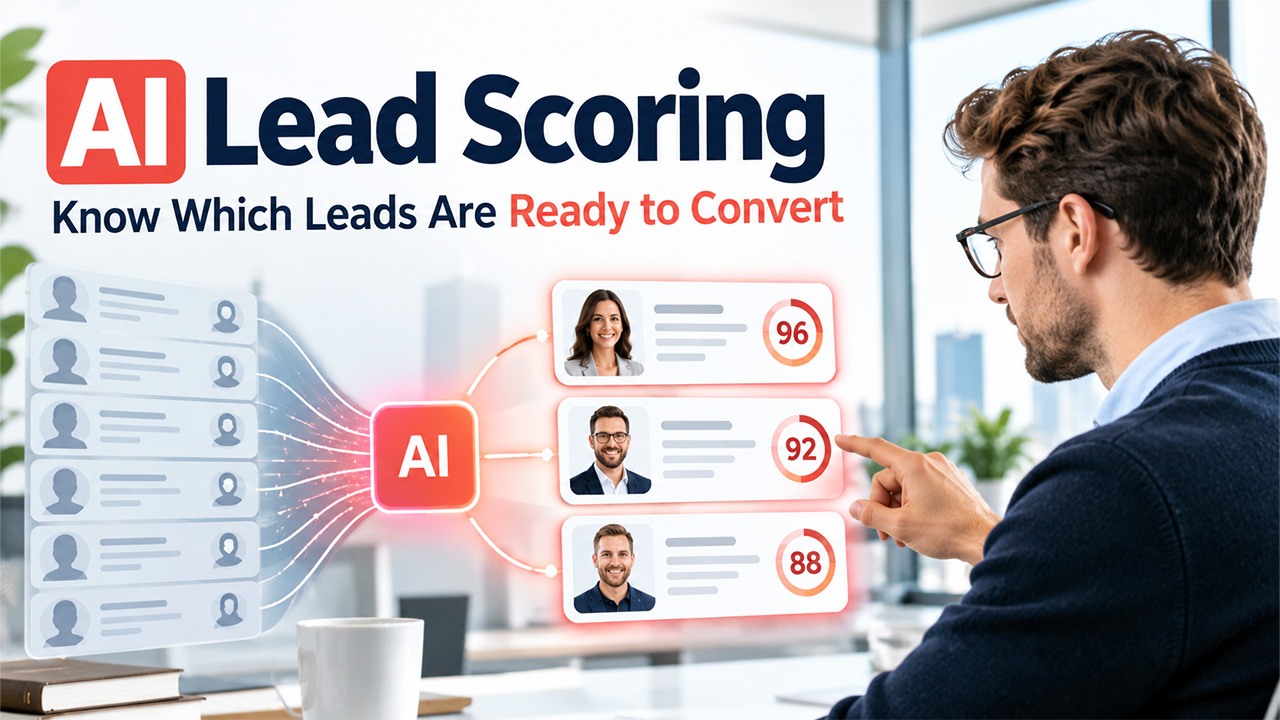
Sales teams manage hundreds of leads each month, and not all of them can be treated equally. The AI Lead Score Calculation Method fixes this issue by utilizing machine learning to forecast which leads have the highest conversion possibility to become paying customers. Instead of depending on manual point systems or gut instinct, this approach assesses behavioral patterns, historical data, and firmographic details to give every lead a numerical score, often between 0 and 100. Marketing and sales teams then utilize this score to prioritize outreach and emphasize their time on prospects that have the best conversion potential.
Understanding AI Lead Score Calculation Method
The AI lead score calculation method refers to a data-based process that utilizes machine learning models to assess leads as per the patterns existing in converted and lost deals. Instead of giving a fixed-point value to actions such as email opens or form submissions, the system evaluates the historical data to learn which combinations of attributes actually forecast a sale.
Main features of this method involve:
- Consistent learning from new conversion information instead of one-time and static rules.
- Pattern recognition across dozens or even hundreds of data points at the same time.
- Score ranges often expressed as a number or a percentage from 0-100.
- Automatic recalculation as further interaction takes place between customers and brands.
This sharply differs from traditional lead scoring, which extensively relies on manually assigned point values that adapt rarely to changing buyer behavior.
Understanding the Working of AI Lead Score Calculation Method
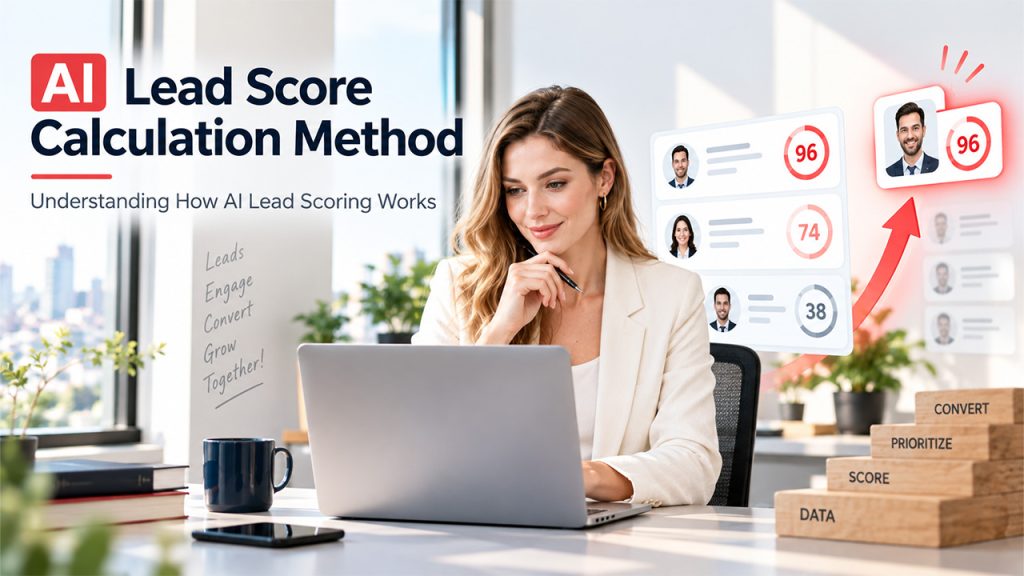
Being familiar with mechanics behind AI-powered lead scoring aids sales and marketing teams rely on the output and effectively utilize it. The processes often follow five key stages:
1. Collection of Data and Integration:
The model extracts data from customer relationship management systems, website interactions, marketing automation tools, and email campaigns. This involves:
- Demographic data (location, job title, or company size)
- Behavioral data (downloads, page visits, or email engagement)
- Firmographic data (revenue, industry, or employee count)
- Engagement data (content interaction, webinar attendance)
2. Data Cleaning and Feature Engineering:
Before training starts, the dataset is comprehensively cleaned to eliminate inconsistencies and duplicates. The system then executes feature engineering, transforming raw data such as “time spent on website” into actionable metrics like engagement scores.
3. Model Training:
The algorithm assesses historical leads that got successfully converted versus the ones that did not, recognizing which behaviors and attributes most correlate with a sale. This is the key idea that drives machine learning lead scoring process, and it generally reveals non-obvious combinations that a manual reviewer can miss.
4. Assigning a Score:
Once the AI is trained, the model provides every new lead with a predictive lead score. An increased score showcases a higher conversion likelihood. A lot of platforms organize this in bands, for instance:
- Below 50: Not likely to convert.
- 50-94: Likely to convert, worth spending sales effort.
- 95 and above: Extremely likely to convert, ready for outreach directly.
5. Continuous Retraining:
Since buyer behavior evolves over time, the model is specifically retrained on fresh data. A few enterprise platforms, like Oracle Sales, retrain their scoring model every month utilizing the previous three years of historical data and recalculate individual scores approximately each 12 hours.
If you are evaluating how AI platforms manage this kind of consistent data refinement more widely, this overview of AI business solutions explains how platforms such as Salesforce Einstein apply such principles across CRM workflows-
Main Factors That Impact the AI Lead Score Calculation Method

Not each data point carries a similar weight in the model. The lead scoring algorithm often assesses the below-mentioned factors:
- Engagement Frequency: How frequently a lead communicates with your emails, website, or content.
- Firmographic Fit: Whether the industry, size of the company, and revenue align with your ideal customer profile.
- Intent signals: Research activity like comparisons of competitors or pricing page.
- Activity Recency: Recent interactions often carry greater weight than older ones.
- Potential of the Deal Size: Bigger opportunities may be differently scored as per your sales priorities.
Marketing teams focus on nurturing leads by creating personalized content generated by AI-driven drafting tools to ensure that the messaging remains consistent across different touchpoints; choose a AI content generator to align your outreach copy with what the scoring model recognizes as high-intent behavior.
Normalizing and Managing High Lead Scores
One possible challenge with the AI lead score calculation method is in managing leads who scores climb at an unusually high rate; even after a status change. The community forums of HubSpot document a prevalent scenario: a lead identified for renurturing still exists above the qualification threshold since their prior score was way too high for a simple point deduction to offset.
A workable solution pertains the following:
- Generating a secondary property that records peak score range of the lead.
- Applying a proportional negative adjustment as per the range instead of a flat deduction.
- Periodically assessing threshold logic to make sure re-nurtured leads prematurely do not trigger qualification.
This type of score normalization ensures that the lead qualification process remains accurate and saves sales teams from chasing leads that look to be promising on paper but have not re-engaged actually.
AI Lead Scoring vs Traditional Lead Scoring
| Aspect | Traditional Scoring | AI Lead Scoring |
| Creation of Rule | Static or Manual point values | Trained from historical results |
| Adaptability | Needs manual updates | Automatically adjusts over time |
| Data volume managed | A group of variables | Simultaneously hundreds of variables |
| Bias | Likely to have subjective assumptions | As per the statistical patterns |
The AI lead scoring model outperforms rule-driven systems since it recognizes non-obvious correlations between attributes instead of depending on assumptions about what needs to matter.
Conclusion
The AI lead score calculation method provides marketing and sales teams a far more dependable way to emphasize prospects than rule-based or manual systems ever could. By learning from firmographic, behavioral, and engagement data, it reveals the leads which is worth pursuing without filtering out the noise. As your historical information grows and the model is retrained, accuracy of scoring enhances, making this approach one of the most reliable investments a revenue team can make in 2026.
Frequently Asked Questions :
How is an AI lead score different from a manual score?
A manual score leverages fixed point values which are set by a person. The AI lead score calculation method trains such weightings from precise conversion data and keeps adjusting them.
What score range reveals a lead which is sales-ready?
These changes by platform. However, a lot of platforms consider scores 85 and above as ready for direct outreach, while mid-range scores indicate a need for more nurturing.
Is there a minimum amount of data that we have to provide to the AI model?
Yes. Most platforms suggest at least six months to three years of clean historical conversion data before forecasts become reliable statistically.
Can the scoring model be personalized?
Many solutions enable you to exclude specific lead types from training or substitute custom attributes. Though, the core model itself often cannot be re-created from basics.