
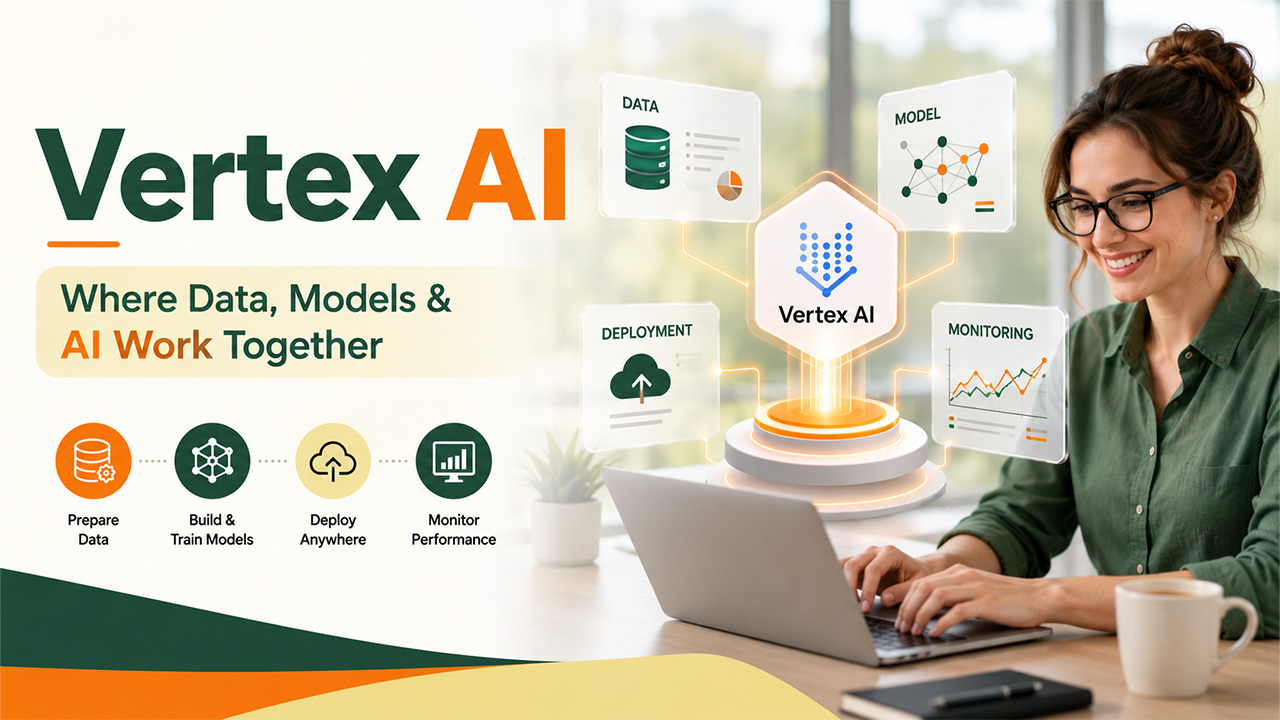
If you’ve ever tried piecing together separate tools for data preparation, model training, and development, you already know how quickly machine learning projects can turn into a tangle of disconnected systems. Vertex AI was built specifically to solve that problem, bringing the entire process under one roof instead of scattered across a dozen different platforms.
Developed by Google Cloud, it offers an integrated environment that will allow the data scientist and developer to have everything in one place without having to change context continuously. The workflow does not involve using various tools in different parts of the process but having everything within one environment, starting from the raw data to the final deployed model.
In this blog, we’ll break down what Vertex AI actually is, how it works under the hood, its key components, and why so many teams are adopting it as their go-to machine learning platform.
What Is Vertex AI?
Vertex AI is Google Cloud’s unified platform for building, training, and deploying machine learning models, all inside one connected environment instead of stitching together separate tools for each stage.
The reason why it becomes truly practical is the broadness of its application across the whole lifecycle. The process of data preparation, model building, training, deployment, and continuous monitoring takes place in the same software suite, thus saving engineers and data scientists from having to export their work eliminates many of the challenges that stood in the way of ML projects before.
It also appeals to all ranges of experience. The platform allows one to pick up pre-trained models to start quickly, use AutoML to construct models without much tuning, and even take the custom path altogether, building the models manually with tools such as TensorFlow and PyTorch. This makes the platform quite an appealing choice for people of different experience levels.
How Does Vertex AI Work?
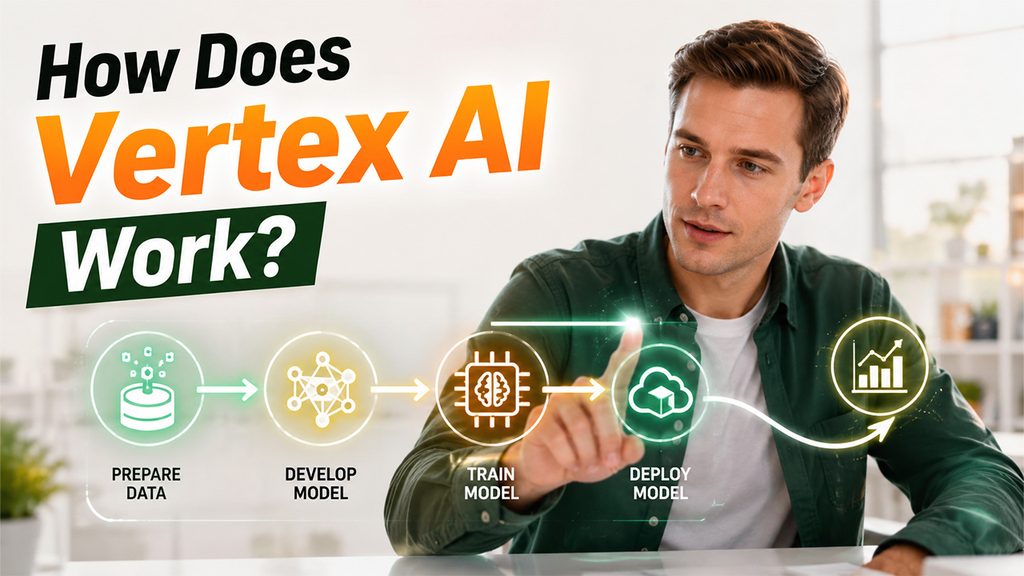
To understand how Vertex AI really works, four interlinked steps deal with various parts of the machine learning lifecycle:
Preparing data: Any machine learning model training requires prior preparation of data. This stage is underestimated by most people because the quality of the data used as an input plays an essential role in determining how good the final model will be.
Developing models: From here, teams choose their path. Built-in pre-trained models help jumpstart projects quickly, while custom models can be built from scratch using frameworks like TensorFlow or PyTorch for teams that need more control. AutoML sits in between, letting users build strong models with minimal manual intervention.
Training models: Once a model’s ready, Vertex AI leans on Google’s own infrastructure to handle training, including distributed training that significantly cuts down the time required compared to training on a single machine.
Deploying models: The final stage turns a trained model into something usable. Models get deployed as API endpoints for real-time predictions, or run through batch processing when predictions need to be generated across large datasets all at once.
Once deployed, the platform doesn’t just stop there either; ongoing monitoring tracks performance and flags things like data drift, so models can be retrained before accuracy quietly starts slipping.
Key Components of Vertex AI
A few core pieces work together to make Vertex AI function as smoothly as it does:
- Vertex AI Workbench: This is the main development environment where actual work such as data preparation, modelling, and deployment happens.
- AutoML: Enables users to build high-quality models easily and thus makes the whole platform truly usable even for users who lack experience in machine learning.
- Model versioning: Keeps the history of iterations of a certain model, helping to maintain and roll back changes much more easily.
- Vertex AI Pipelines: Enables users to create workflows for their ML projects to automate them as much as possible.
- Model monitoring: Continuous monitoring of the performance of deployed models, alerting about data drifts and other issues.
Overall, these components become the real reason for Vertex AI to become a true platform and not just an ensemble of different tools where each component is responsible for its place in a lifecycle without the need for other systems integration.
Advantages of Vertex AI
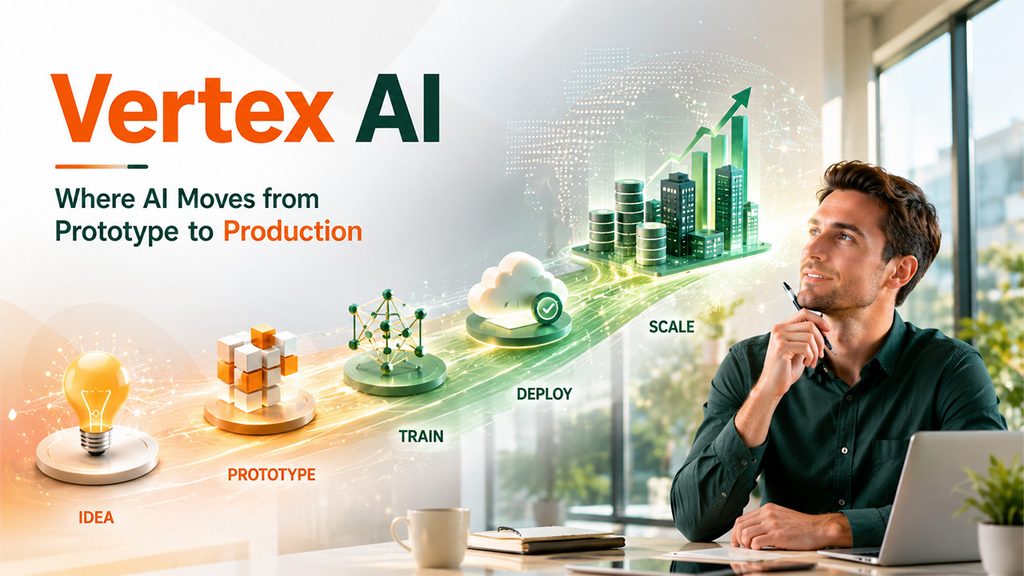
Beyond the individual features, here’s what actually makes Vertex AI worth adopting for teams weighing their options:
- Ease of use: A genuinely user-friendly interface paired with pre-built models means teams don’t need deep machine learning expertise just to get started.
- Efficiency: Running on Google’s own infrastructure speeds up both training and deployment, which cuts down the time and cost typically involved in building ML solutions.
- Scalability: Whether it’s a small prototype or an enterprise-level application, the platform adapts to the scale a project actually needs.
- Reliability: Backed by Google Cloud’s infrastructure, it offers the kind of uptime and dependability that larger organizations need to trust before deploying anything mission-critical.
- Integration: Connects seamlessly with other Google Cloud services, extending what a team’s AI applications can actually do without needing separate, disconnected tools.
- AutoML capabilities: Automates a meaningful chunk of the model development process, opening the door for a much wider range of users to build something functional.
Taken together, these advantages are really why Vertex AI has become a serious contender for organizations trying to move from experimenting with AI to actually deploying it at scale.
Why Businesses Are Adopting Vertex AI
The demand for platforms like Vertex AI really comes down to one thing, AI development has gotten more complex, and organizations need a way to manage that complexity without hiring a massive specialized team just to keep up.
Simplicity of development plays a key role in the attractiveness of MLaaS. Teams lacking expertise in machine learning can still develop and deploy functional models because of the availability of ready-made tools and the automation of the most tedious tasks in the AutoML process. This is important in more ways than one, considering that it allows for competition from less technologically powerful players.
Speed matters just as much. By running on Google’s infrastructure, Vertex AI meaningfully shortens the time between an idea and a working, deployed model, which directly affects how fast a business can actually act on what its data is telling it.
There’s also a consistency factor worth mentioning. Standardized practices for model development and deployment reduce errors and keep quality steady across projects, something that gets harder to maintain as more people and models get added to the mix. This is exactly the kind of reliability organizations look for when evaluating AI business solutions for real, ongoing use rather than short-term experiments.
Conclusion
At the end of the day, Vertex AI solves a problem a lot of teams didn’t even realize they’d normalized, the friction of stitching together separate tools for every stage of a machine learning project. By bringing data preparation, training, deployment, and monitoring into one connected platform, it removes a meaningful amount of complexity from what used to be a genuinely fragmented process.
That matters more now than ever, as AI keeps becoming a bigger part of how businesses actually operate day to day. Platforms like this are a real part of how evolving AI in modern businesses is playing out, not as a one-time tool adoption, but as infrastructure that keeps adapting alongside the organizations using it.
Whether you’re a small team just getting started with machine learning or an enterprise scaling existing AI infrastructure, Vertex AI offers the kind of flexibility and reliability that makes it worth serious consideration.
Frequently Asked Questions
Q. Is Vertex AI free to use?
Vertex AI provides a limited free tier service, but any serious usage of Vertex AI is unlikely to stay within this scope, since the cost is determined by compute costs, storage needs, and API requests.
Q. Do I need coding experience to use Vertex AI?
No, it is not necessary. With the AutoML feature, one can develop models with minimal human involvement. However, custom models that use platforms such as TensorFlow and PyTorch are dependent on coding skills.
Q. What’s the difference between Vertex AI and Google Cloud AI?
Vertex AI happens to be an element of the Google Cloud AI family of products and services dedicated to the life cycle of machine learning. Google Cloud AI is the overarching name for a set of AI/ML products, Vertex AI included.
Q. Can Vertex AI handle large-scale enterprise projects?
Yes, it’s built to scale from small prototypes to enterprise-level applications. Backed by Google’s infrastructure, it supports distributed training and handles the increased demand that comes with larger, more complex machine learning projects.
Q. What frameworks does Vertex AI support for custom models?
It allows the use of popular frameworks such as TensorFlow and PyTorch, allowing the developer to build models from scratch using whichever framework they prefer, rather than having to use just pre-made models or AutoML.