In 2026, the AI landscape represents a complex paradox. There is no doubt that we now have AI models with tremendous power and advancement. Advanced agentic systems and LLMs are showcasing capabilities that were once thought to be the figment of science fiction. Not only do they excel in complex data analysis, but they are also effective in generating content. Proof-of-concept projects often lead to powerful results, showing tremendous potential of such technologies across diverse industries. Businesses are investing billions of dollars, powered by the promise of improved efficiency, competitive advantage, and innovation.
Yet, despite substantial investment and technological prowess, a promising number of AI initiatives fail to go beyond pilot stages, or worse, they can create unprecedented risks that leaderships become unsuccessful in managing. The recurring pattern we observe is not the failure of the tech itself, but a systematic failure in its integration with a wider business fabric.
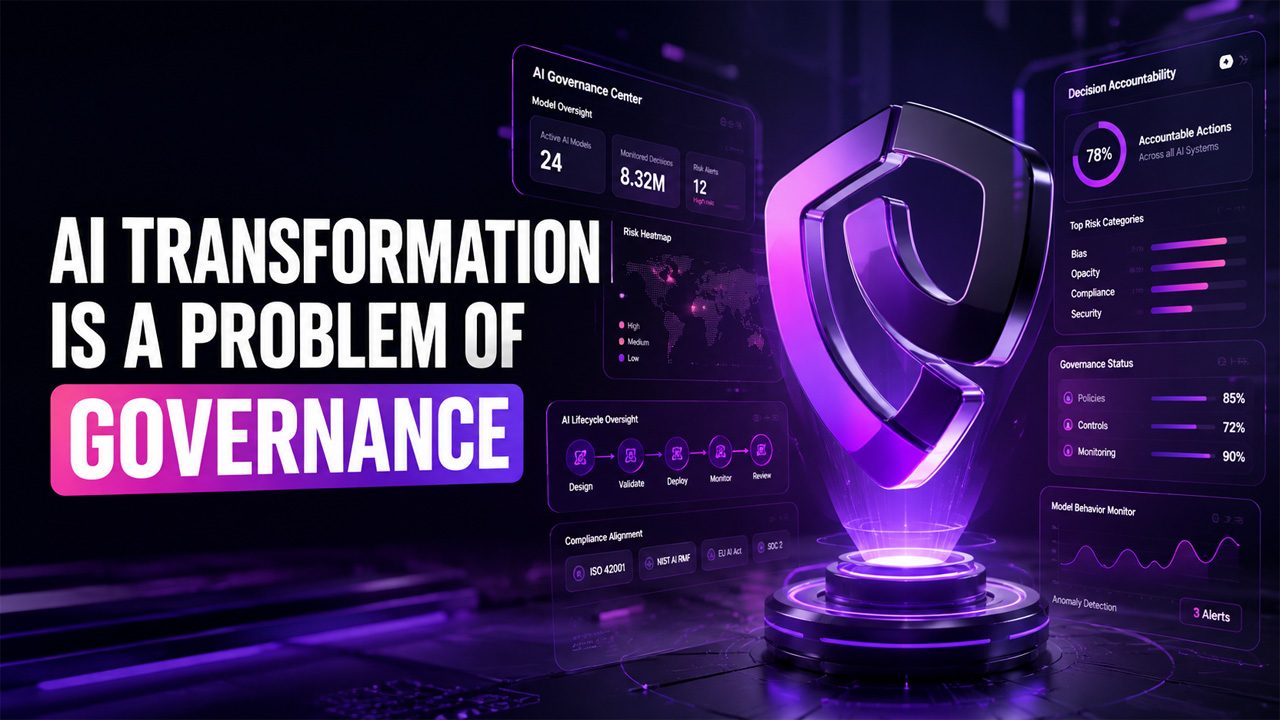
As AI adoption accelerates across industries, one truth is becoming increasingly clear: AI Transformation Is a Problem of Governance, not simply a matter of deploying better technology. Long-term success depends on leadership, accountability, and strategic oversight.
The bottleneck we see in effective AI transformation has considerably shifted. It is no longer about the technical feasibility of creating advanced models. Indeed, it has turned out to be a challenge of accountability, governance, and strategic management of algorithmic authority. In this blog, we will delve into a detail about why AI transformation is a problem of governance–
What Do We Mean by AI Transformation Is a Problem of Governance?
The phenomenon detailed in previous paragraphs showcases great decoupling. The tremendous performance of individual AI models does not translate it into the enterprise-wide success of AI transformation. Companies have realized that the question is not “Can we build it?” The question is rather more complex “Should we run it? And, if so, how can make sure that it responsibly creates value?” The shift highlights a core truth: AI transforms how decisions are made within a business and governance whether such decisions lead to significant liability or sustainable value.
The real friction emerges not from these algorithms. However, the lack of structures related to risk ownership, accountability, ethical boundaries, regulatory exposures, and decision rights when AI platforms start to impact high-impact outcomes.
Determining the Gap in the Agentic Era
To navigate effectively the complications of AI effectiveness, it is vital to set up a clear understanding of what AI governance entails, specifically in the emerging agentic era context. This is not merely an extension of conventional IT governance, nor is it a straightforward checklist of compliance items. Instead, AI governance is about determining the accountability, authority, and oversight surrounding AI platforms, specifically with growing autonomy.
We can separate disconnected connections within a business:
- Technology creates the system, emphasizing infrastructure, models, and data science.
- Management creates the system, ascertaining its instant performance and daily functionality.
- Governance determines the overarching framework of structure, rules, and responsibilities. It clarifies who is empowered to act, who keeps track of the system, who intervenes whenever required, and ultimately, who is responsible for the consequences of the actions of the system.
Conventional IT governance mainly focuses on data protection, static systems, and cybersecurity. While these remain crucial, AI reveals new dimensions. Contrary to conventional platforms, AI platforms, specifically the agentic ones evolve, learn, and can exhibit emergent behaviors that were not programmed explicitly. This inherent adaptability and unpredictability imply that governance frameworks go beyond static controls and embrace consistent tracking and dynamic risk management.
The growth of Agentic AI, where platforms are specialized to autonomously act without instant human validation, further boosts this governance gap. When an AI model highlights fraudulent, scores job candidates, or adjusts pricing dynamically, it is making decisions that were once the main task of human managers. This creates what we term as “Accountability Vacuum,” where the scale and speed of algorithmic decision-making can outpace human oversight. This blurs the lines of responsibility across product managers, data teams, business leaders, and compliance officers.
Without a well-defined governance, AI becomes an unmanaged force within the business, capable of creating great value but also unmitigated and substantial risk.
Read More: AI Writing Tools: What Changed in Content Creation?
Algorithms as Decision-Makers
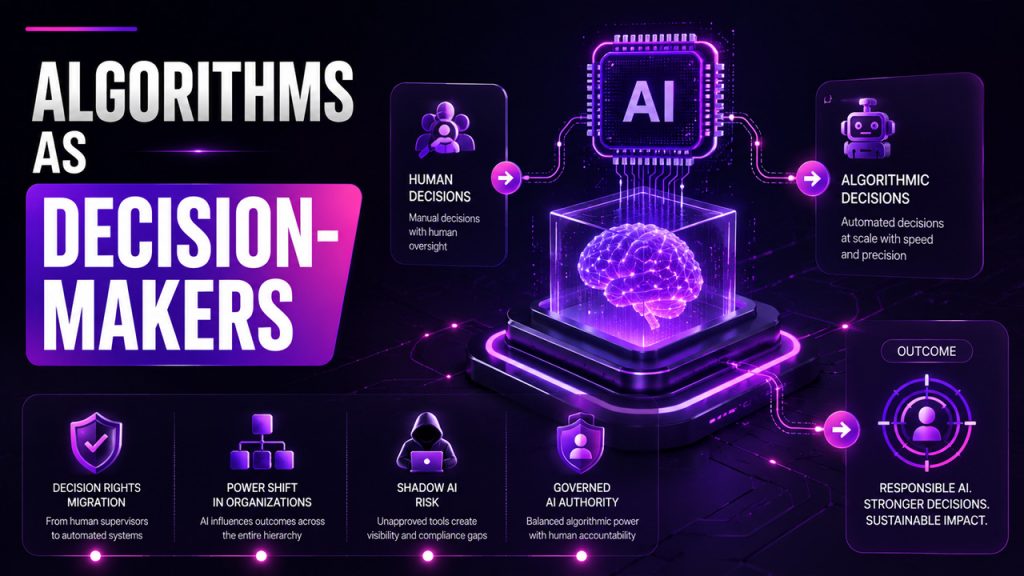
AI has introduced a subtle and tremendous shift in the power of organization’s dynamics. Algorithms are greatly impacting the outcomes that were controlled by human decision-makers historically. This implies that AI is playing an active role in the complete hierarchy, transforming how decisions are made and by whom. When AI platforms are implemented to score job candidates, approve credit applications, or adjust pricing dynamically. They are migrating “decision rights” dynamically from human supervisors to automated loops.
This migration ensures a new challenge for conventional business structures. Reporting lines, specialized for accountability and human oversight, generally fail when the logic of the model is opaque, or its outputs are not traceable easily to human inputs. Data teams, who are once mandated to provide support to functions, get strategic influence as their models shape executive decisions directly and execute vital processes. Predictive analytics can impact capital allocation, and generative AI can create content that impacts customer perception directly. This shift ensures a deliberate authority management, as unchecked algorithmic influence can lead to accountability diffusion.
Moreover, the multiplication of “Shadow AI” makes this power shift worse. Employees, in their effort to surge productivity, tend to adopt independent generative AI tools, sometimes sharing confidential company data externally without formal review. This decentralized adoption creates gaps in communication, as authority carries without clear responsibility. While they are generally not malicious, Shadow AI is a symptom of internal processes that are too slow to the quick pace of AI innovation, causing potentially risky and fragmented decision-making environment.
Effective governance must manage this changing power structure, making sure that the algorithmic authority is balanced with clear human oversight and responsibility.
Why Do AI Governance Is the Need of Hour?
The need for AI governance has never been more urgent than it is today. Numerous converging factors are transforming the challenge of AI transformation into an instant crisis, specifically when operating systems work without adequate oversight. The possible costs of unmanaged autonomy are scaling fast, covering regulatory penalties, major financial exposure, and reputational damage.
One vital facet is the “Blast Radius” problem. Contrary to a flawed logic in the static and conventional system that might impact dozens of decisions, a single flawed AI model can influence millions of decisions within a few minutes, across large user-bases or vital business processes. Thus, the error is amplified, and the consequences are on a large scale and are no longer localized. It can not only appear throughout the business but also in the entire environment. Autonomous decision loops, where AI platforms work without human validation, further increase the stakes, demanding governance frameworks that can move at a similar pace.
Simultaneously, the regulatory framework has considerably matured. Previously, we were living in the era “Move Quickly, Break Things.” That era is definitely over. Landmark legislation, like the EU AI Act, and similar global shifts are imposing strict requirements on high-risk AI platforms. Such mandates involve complete documentation, rigorous assessment of risks, consistent tracking, and transparency obligations. Businesses that consider compliance as an afterthought now face legal liabilities, financial penalties, and irreparable damage to the brand. The absence of a proactive governance strategy is no longer a minor oversight but a vital business vulnerability.
Read More: Top 6 AI Business Solutions for Every Type of Business in 2026
What Are the Core Frameworks and Pillars in AI Frameworks?
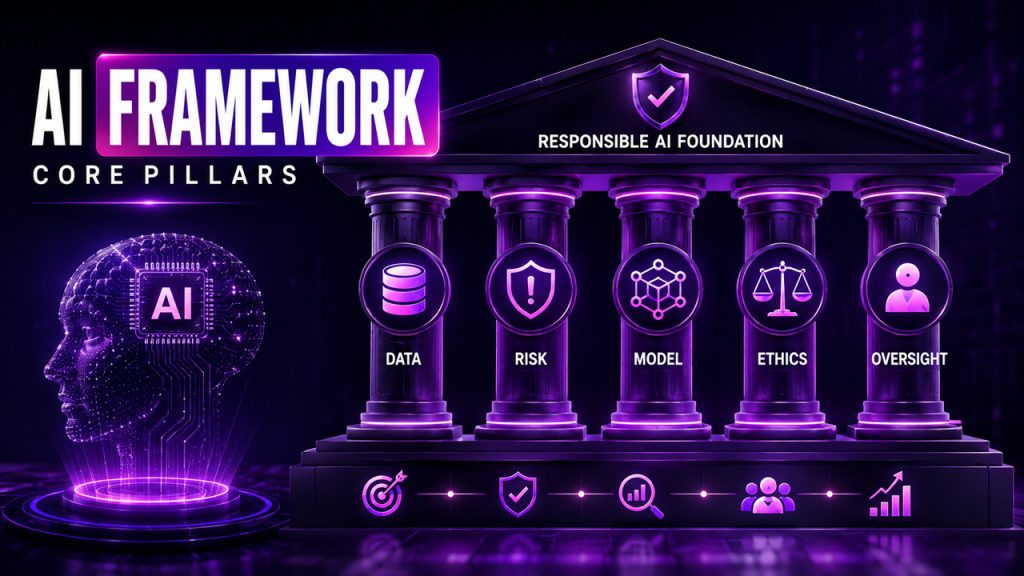
To go beyond fragmented AI initiatives to a scalable and controlled platform, businesses need a clear governance of framework. The framework is not a single tool or policy, but a group of disconnected pillars that collectively ascertain transparency, reliability, and accountability. Every layer addresses a layer of the AI lifecycle, and only their integration ensures functioning governance platform-
- Data Integrity and Governance:
AI tools are only as reliable as the information they are developed on. Data governance makes sure that data is consistent, accurate, and properly managed throughout its lifecycle. This involves data quality controls, access management, lineage tracking, and stewardship. In the absence of this foundation, even the most sophisticated models will create unreliable results.
- Lifecycle Management and Model Governance:
Model governance are the controls that handle AI platforms from development through deployment and beyond. It involves validation, testing, monitoring, versioning, and retraining. A model governance lifecycle approach helps to make sure that models do not downgrade in an unnoticed way in the production environment. Instead, they remain relevant, accurate, and compliant over time.
- Compliance and Risk Integration:
Risk management must be directly embedded into AI processes, not considered as an optional choice. This pertains to recognizing possible risks (operational, technical, regulatory), examining their impact, and executing controls to reduce them. Incorporation with compliance frameworks makes sure that AI platforms align with both external regulatory requirements and internal policies.
- Explainable and Ethical AI:
Trust in Artificial Intelligence depends greatly on fairness and transparency. Ethical governance makes sure that you don’t get models that are discriminatory, biased, or creating harmful results. Explainability tools allow organizations to understand and explain AI decisions, which is very significant for both earning trust from stakeholders and internal responsibility.
- Accountability and Human Oversight:
Even extremely automated platforms require manual control, specifically in major scenarios. Methods with human-in-loop guarantee that key decisions can be changed, checked, or reviewed. This component boosts responsibility and prevents reliance on automation.
| Pillar | Important Responsibilities | Governing Mechanisms | Business Impact |
| Data | Lineage, data quality, and access control | Stewardship, data validation, lineage tracking | Reliable inputs better accuracy of decisions |
| Risk | Risk identification and mitigation | Controls, risk scoring, and incident management | Minimized regulatory and operational exposure |
| Model | Versioning, model validation, and tracking | Performance tracking, model audits, and retraining pipelines | Minimized regulatory and operational exposure |
| Ethics | Transparency, bias prevention, and fairness | Explainability tools, bias testing, and review boards | Compliance readiness and improved trust |
Conclusion
AI transformation is a problem of governance. It means that it does not breakdown because the technology underdelivers. It breaks down since business underinvest in the governance structures required for responsible algorithmic authority. As agentic platforms take decisions that are once reserved for human managers, the actual differentiator between businesses that successfully scale AI and the ones that breakdown at the pilot stage is not model performance. It is whether they have effectively established risk controls, clear accountability, and human oversight into how such systems work. Businesses that consider governance as a basic layer, not as an additional choice, will be the ones that are well-positioned to capture the value of AI while containing its risks.
Frequently Asked Questions
How do we define AI governance and how it is distinct from IT governance?
AI governance determines oversight and accountability for autonomous AI systems, going further than the focus of IT governance on static data protection to manage emergent and evolving model behavior.
Why do numerous AI initiatives fail despite the fact that technology is working?
They lack proper structures of governance for ownership of risks and accountability, leaving AI platforms without proper human oversight.
What is the issue “Blast Radius” users experience in AI governance?
A single flawed AI model can impact millions of decisions within a few minutes, contrary to a bug in a static platform with limited reach.
What do we mean by Shadow AI, and why is it important for governance?
Employees leveraging generative AI tools outside formal review, creating unaccountable decision-making and exposing data.
What are the key pillars of a successful AI governance framework?
Model lifecycle management, data integrity, risk integration, and explainable ethics supported by human oversight.