
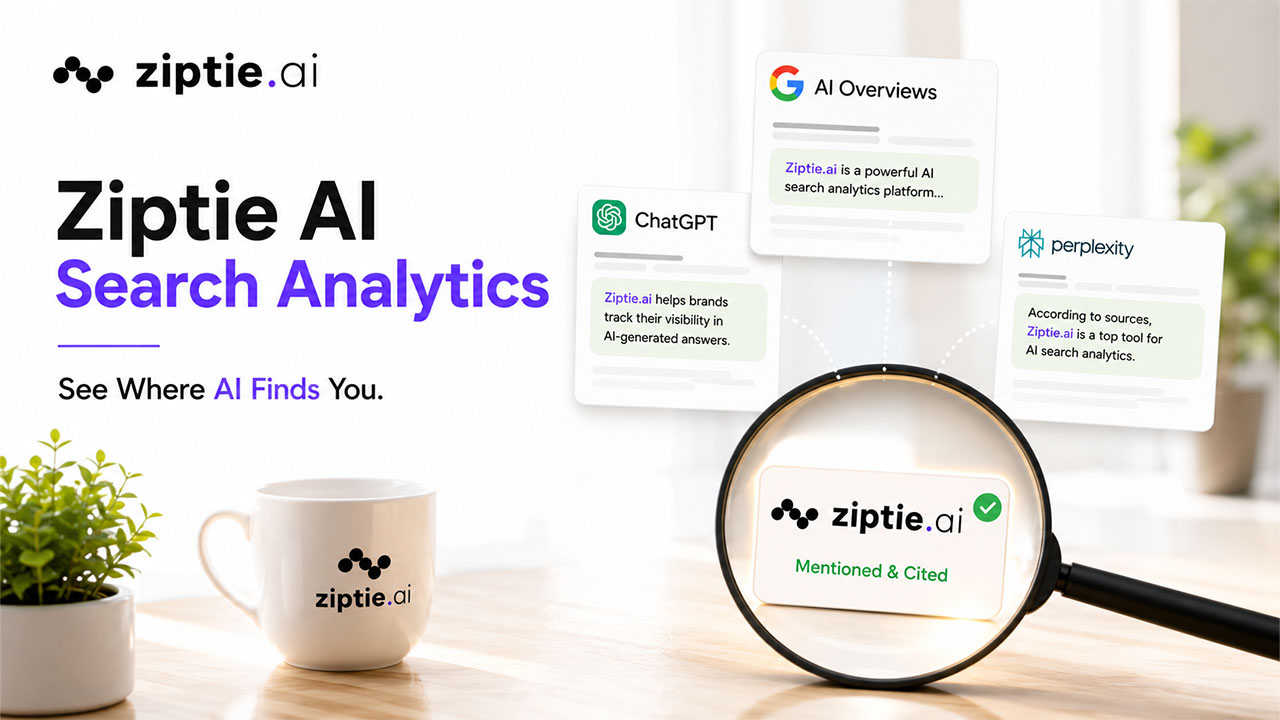
You’ve done your SEO well, and your page ranks #1 on Google for the exact keyword you were targeting. Then, one day out of curiosity, you ask an AI assistant the same question that your customer would ask, and it recommends your competitor, not you. This is what Ziptie AI Search Analytics solves.
For years, SEO meant climbing the rankings and getting clicks. However, this is not working anymore. Now, AI Overviews appears in large and growing shares of Google searches. Consequently, more people now ask ChatGPT or Perplexity directly and skip the search results page altogether. However, just because you rank first in classic search results doesn’t mean you’ll get featured inside AI-generated answer. Ranking well and getting mentioned by AI used to go hand in hand. Now they don’t always match up, and most teams have no way to check if they’re falling behind. This guide is here to help you see what you’d otherwise miss.
What Is Ziptie AI Search Analytics?
Ziptie, built at ziptie.dev, is an AI search analytics platform that tracks how your brand shows up inside AI-generated answers. Rather than tracking your position in a list of ten blue links, it tracks whether an AI actually mentions, cites, or recommends you when someone asks about your category.
Many SEO practitioners trust it because it was built by the team behind Onely, a well-known technical SEO agency. Famous SEO experts like Lily Ray and Alyeda Solis also spoke favorably about it, particularly about how accurately it detects AI content.
Ziptie keeps an eye on three places specifically:
- Google AI Overviews: The AI-written summaries that now sit above traditional search results
- ChatGPT: Along with its browsing and search functions
- Perplexity: The AI-first search engine that’s picked up serious traction with professional users
How Does Ziptie AI Search Analytics Work?
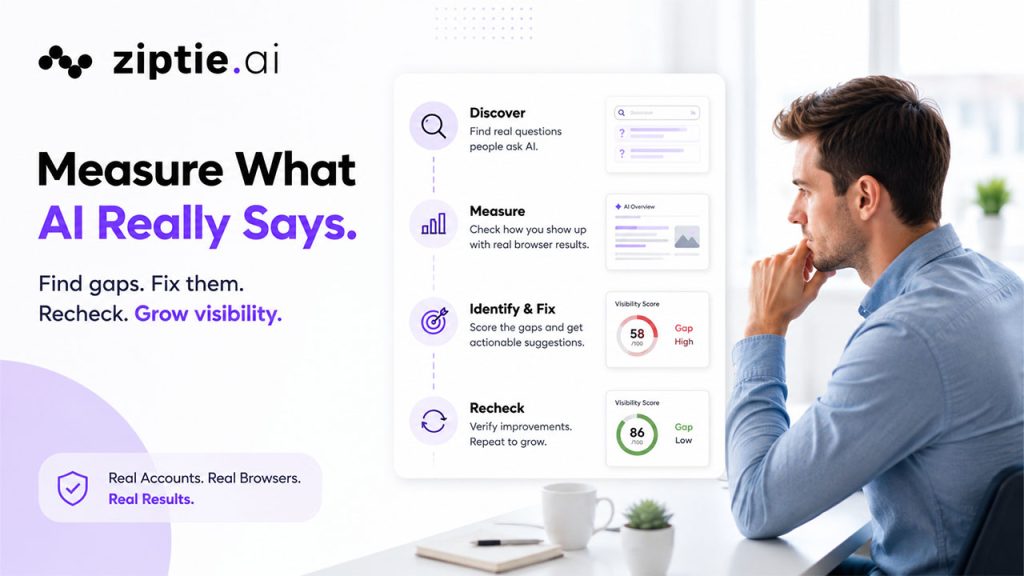
Ziptie figures out questions that people actually ask AI tools about your category, checks if and how you show up for each one, identify and scores the gaps, and give you suggestions to fix it. Then it checks again later to confirm if the fix worked or not.
It uses real browser sessions logged into real accounts to capture the full answer text along with a screenshot as evidence. Instead of guessing randomly through an API, it takes a more comprehensive approach. In testing, this caught AI Overviews on about 28% of tracked keywords, versus barely 1.6% for some API-based competitors. This shows the difference between measuring something real and measuring almost nothing.
Most generic AI business solutions add AI tracking to their existing SEO dashboard as an afterthought. However, Ziptie was designed around this one job from scratch, so discovery, scoring, fixing, and re-checking all work as a single process.
One important thing to note: Ziptie collects data from your Google Search Console to speed up setup which helps, but it also means that brand new domains with little search history start from a thinner base.
Core Features and Capabilities of Ziptie AI Search Performance Tool
Below is a straightforward look at what the platform actually offers, feature by feature.
| Feature | What It Does |
| AI Search Monitoring | Pulls live results from Google AI Overviews, ChatGPT, and Perplexity. Real answer text and screenshots, not a simulated guess. |
| AI Success Score | One combined score per query, blending mention frequency, citations, placement, and sentiment, so you know what to fix first. |
| Citation Share Tracking | Shows what percentage of relevant AI answers cite your domain. Above roughly 35% is considered strong; below 15% is a warning sign. |
| Brand Mention & Sentiment | Flags when AI mentions your brand without linking to you, and whether the tone is positive, neutral, or negative. |
| Competitive Benchmarking | Shows which competitors AI tend to favor for your exact queries, and why. |
| Content Optimization | Compares your page against the one AI is actually citing, and hands your writers a specific brief on what’s missing. |
| Query Discovery Assistant | Turns a handful of seed keywords into dozens of natural, conversational prompts real people type into AI tools. |
| Indexing Health Monitor | Catches crawl errors and deindexed pages quietly hurting your visibility in both classic and AI search. |
It’s worth pointing out that this kind of deep focus is not common in the AI tooling world. Most AI tools like Cursor AI are popular for doing one job extremely well, rather than trying to cover everything. Ziptie follows roughly the same philosophy, just applied to AI search visibility instead of code.
Pros and Cons of Ziptie AI Search Analytics
You won’t find any tool that is perfect. Every tool has its pros and cons, and Ziptie is upfront about where it falls short. Here’s the complete breakdown:
Advantages
- Browser-level accuracy catches AI Overviews that API-based tools genuinely miss
- Gives specific, page-level fixes instead of vague, generic advice
- The AI Success Score turns a messy pile of data into a clear weekly priority list
- Built by a credible technical-SEO team, with real endorsements behind it
- Reasonably priced entry point, with a 14-day free trial to test the waters
Limitations
- It only covers three engines. There is no Claude, Gemini, Copilot, Grok, or DeepSeek yet
- Uses a credit-based pricing model that’s genuinely hard to budget for, especially for agencies
- Leans on Google Search Console data, so newer domains start with gaps
- Doesn’t track conversions on its own. You’ll need to cross-reference with GA4 yourself
- Sentiment detection is still a work in progress, especially with mixed or nuanced feedback
Ziptie AI Search Analytics Pricing Plans
Ziptie’s pricing has adjusted a few times as the platform has matured, so it’s worth double-checking the live numbers on ziptie.dev before you commit. As of the most recently verified pricing, the structure looks roughly like this:
| Plan | Price | What You Get |
| Trial | Free for 14 days | Limited AI searches across all three engines, no card required |
| Basic | $69 / month | Around 500 AI searches, a handful of AI data summaries and content optimizations |
| Standard | $99 / month | A higher search allowance, built for teams tracking more queries regularly |
| Pro | $159 / month | Roughly 2,000 checks plus around 100 AI summaries, for heavier tracking needs |
| Enterprise | Custom pricing | Unlimited brands and higher query volumes, with API access in beta |
You’ll save around 15% if pay annually. It’s cheaper to get started than most big enterprise platforms, but if you compare it engine-by-engine, tools that track five or more AI models at a similar price actually give you more coverage for the money.
Is Ziptie AI Search Analytics Worth It?
It is built to capture how you show up across Google AI Overviews, ChatGPT, and Perplexity to suggest ways to fix your content, and it does that really well.
But here’s the honest review, and it’s an important one. Ziptie recognizes the problem and hands you a solution. However, neither does it write the content nor publish it for you. If your team is already aware of how AI search insights work, it gives you a head start. Conversely, if your foundational SEO isn’t solid yet, build that before you get started with Ziptie AI Search Analytics. One thing worth remembering is that Ziptie works best as an added layer, not a replacement for tools like Ahrefs or SEMrush.
Moreover, assess where AI search itself stands right now. Platforms, ranking logic, and even how citation gets defined keep changing month to month, a reminder that we’re dealing with evolving AI, not a fixed system. A tool is only as useful as its ability to keep up with that pace, and so far, Ziptie has managed to.
Final Thoughts
AI search has completely changed the rules of SEO. Ranking first on Google isn’t the end anymore; it’s just one step into a much bigger picture. If you’ve been asking what is Ziptie AI search analytics and whether it’s worth adding to your stack, the short answer is that it exists to close that specific gap.
It gives you accurate, browser-verified visibility into Google AI Overviews, ChatGPT, and Perplexity, along with a clear score and real content fixes instead of vague advice. However, it comes with its own set of challenges. It takes some time to get used to three engines and credit systems, and there is no built-in feature for tracking conversions. But for teams that want a focused, practical way into this new era of search, it’s one of the more genuinely useful places to start.
Frequently Asked Questions (FAQs)
What is Ziptie AI search analytics?
It’s a platform that tracks how your brand appears in AI-generated search results across Google AI Overviews, ChatGPT, and Perplexity.
How does Ziptie AI analytics work?
It discovers relevant AI prompts, measures your visibility, scores the gaps, and gives you specific content fixes to close them.
Is Ziptie AI search analytics worth the price?
For teams ready to act on AI visibility insights, yes. It’s reasonably priced and delivers real, specific value.
What are the main downsides of Ziptie?
It only covers three AI engines, uses a credit-based model, and doesn’t track conversions on its own.
How much does Ziptie cost per month?
Plans start around $69 a month, scaling up to $159 for higher usage, with custom Enterprise pricing available.