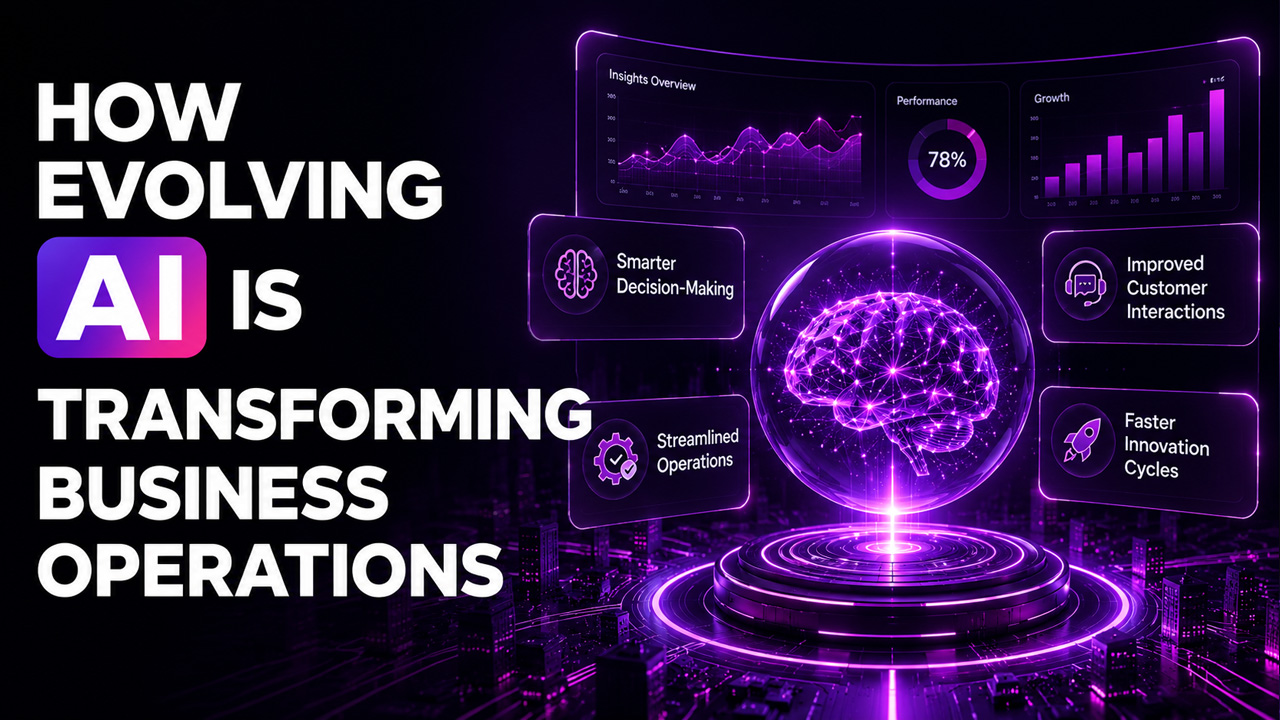
The pace of evolving AI has gone from impressive to almost difficult to keep up with. What started as a concept largely confined to research labs and science fiction has quietly become one of the most significant forces reshaping how businesses operate, compete, and grow in the modern world.
Only a couple of years ago, artificial intelligence was thought to belong only to major tech corporations. These days, any company can use it for process automation, customer knowledge gathering, and decision-making to speed things up. The difference between businesses that have already embraced AI and those that have not yet done so starts to manifest itself.
This blog post will discuss AI transformation processes within modern businesses, places where artificial intelligence solutions are particularly useful, and what needs to be done to implement artificial intelligence in the work of a business.
What Is Evolving AI?
In simple terms, evolving AI can be defined as the constant development and improvement of artificial intelligence technologies that change their nature and work according to learned algorithms, but not the pre-defined and fixed ones. Evolving AI technologies improve their work with experience, in contrast to static technologies that do everything exactly as they were programmed. The difference between evolving AI and automation technologies, used by businesses for decades, lies here.
The main components of evolving AI are machine learning, deep learning, natural language processing, and computer vision. These technologies have developed considerably in the last decade, making the use of AI applicable for more complicated situations across various industries.
This trend becomes relevant because of the pace at which AI evolves. The transformation of AI was and still is a continuous process, and business organizations that keep track of changes in this field will benefit greatly from it.
Why AI Transformation Matters for Modern Businesses
Only recently has the implementation of AI technology been viewed as a competitive edge that separates progressive companies from others. Today, it tends to become a standard practice. Companies that have not yet begun to transform through the implementation of AI risk not only losing some potential benefits but also being left behind by competitors that are operating faster and smarter.
It is hard to underestimate the magnitude of this revolution. AI is no longer seen as an instrument that allows one to automate monotonous and routine operations. Contemporary solutions powered by AI help businesses to predict demand, tailor customers’ experiences, detect fraud, optimize hiring processes, and even make complicated decisions without a team of analysts.
However, at this stage, what is crucial for the company is not to have the best AI Technology. Instead, it is important to figure out how AI may be useful to the company.
How Evolving AI Is Transforming Business Operations
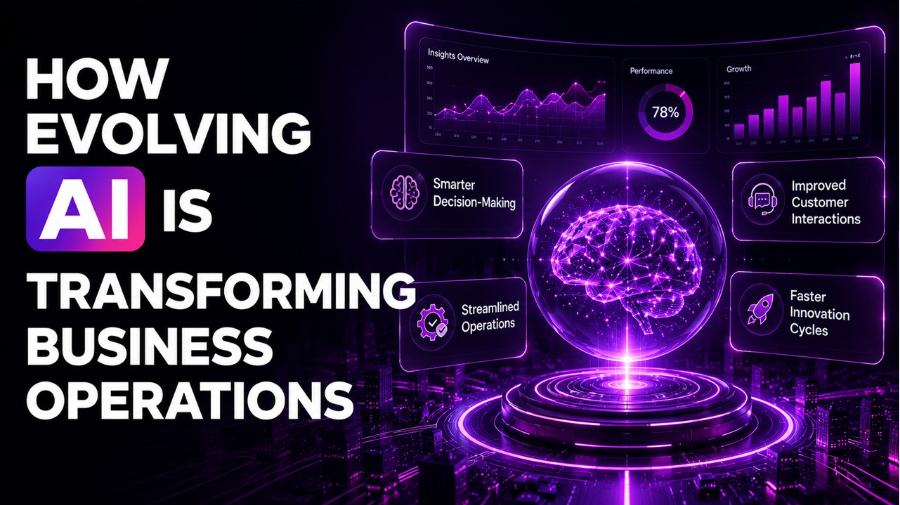
The most visible way that advancements in AI affect business operations does not come down to one specific type of tool, but rather to the fact that AI is becoming embedded into daily operations within businesses. Work that once took much manual labour, intuition, and time can now be revolutionized by using AI within a company.
- Smarter Decision-Making: Perhaps one of the greatest effects that AI has had on businesses thus far is decision-making through data. Businesses can no longer base decisions on gut feelings and past reports; they have begun to take advantage of data analysis through AI to find patterns that were previously invisible and make truly informed decisions.
- Streamlined Operations: Time-consuming tasks that were previously taking up employees’ time are slowly being taken care of by AI systems. Processes such as invoice processing, inventory management, scheduling, and quality control are being automated using artificial intelligence, and building a structured AI Workflow around these tasks is what allows businesses to scale these efficiencies consistently across departments.
- Improved Customer Interactions: AI has also revolutionized the way in which businesses interact with their clients. Recommendations made by an individual based on previous experience, intelligent chatbots, proactive support, and marketing are some examples of AI that are transforming customer interactions.
- Faster Innovation Cycles: Less obviously but very relevantly, new advancements in AI are speeding up the innovation cycles of businesses. It is now possible to analyse and come up with results within a few days of analysing a situation, compared to the old way of months of analysis.
Key Areas Where AI Is Making an Impact
Evolving AI is showing up across nearly every business function, but a few areas are seeing particularly significant change worth paying closer attention to.
Customer Service and Support
Artificial Intelligence has revolutionized the economics of customer support. Automated chatbots or virtual assistants take care of regular customer queries round the clock, while AI tools assist humans in solving more complex customer problems. The result is prompt responses, uniform experiences, and scalable support services without the need for increased staffing.
Marketing and Personalization
Modern marketing is highly dependent on artificial intelligence technologies, which make segmentation, behaviour prediction, and mass customization of content automatic. For creative teams, tools like AI Storyboards are also becoming part of this shift, helping visualize campaign concepts and content plans faster than traditional methods.
Finance and Risk Management
AI is already used for real-time detection of fraud, automation of financial reports, and modelling of different risk scenarios, all of which cannot be achieved by manual efforts. Such technologies are becoming increasingly necessary for businesses working in regulated industries.
Human Resources and Hiring
By reducing manual effort in the screening process, interviewing applicants, and analysing data about employee satisfaction and retention rates, artificial intelligence is simplifying those aspects of the human resources function that are typically time-consuming for HR departments and allowing them to concentrate on the human aspect of their job.
Supply Chain and Operations
Artificial Intelligence is assisting companies in predicting demand more efficiently and optimizing logistics processes while detecting possible disruptions in advance.
How Businesses Are Actually Using AI Today
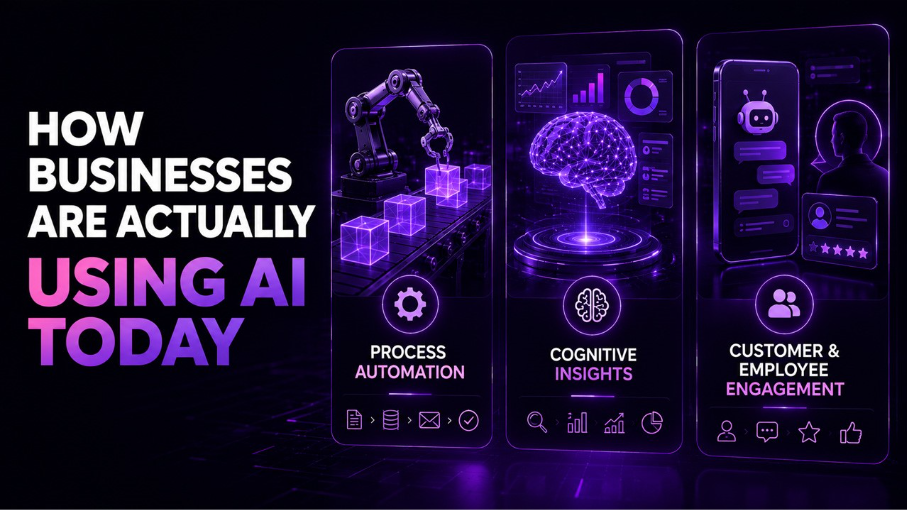
Understanding where evolving AI is making a difference in theory is one thing but seeing how businesses are putting it to work tells a more grounded story. Most real-world AI applications fall into three broad categories.
Process Automation
For new organizations to adopt AI, this is often the first step. It refers to employing artificial intelligence solutions to handle repetitive tasks such as data entry, document processing, invoices, customer communication, among others, and performing already available activities in an effective and inexpensive manner.
Cognitive Insights
In addition to automation, this area uses artificial intelligence to get information from a huge amount of data that cannot be manually processed. It includes activities such as analysing customer behaviour, sales trends, predicting results from previous patterns, and so on, enabling organizations to make informed decisions and solve issues even before they occur.
Customer and Employee Engagement
This involves the use of AI to create better engagements with the customers and employees of an organization. Activities in this case include personalized recommendations, intelligent onboarding, support assistants, and many more, making engagements personalized and timely.
Most businesses start with process automation, where the ROI is clearest, then gradually expand into insights and engagement as their confidence with AI transformation grows.
How to Start Implementing AI in Your Business
For most businesses, the biggest barrier to adopting evolving AI isn’t the technology itself; it’s knowing where to begin. The most practical starting point is identifying a specific problem worth solving rather than trying to implement AI across the entire business at once. Picking one area where the pain is clearest gives AI adoption a clear focus and makes it much easier to measure results.
From there, choosing the right tools matters more than choosing the most advanced ones. Integrated platforms like AISuites are worth considering since they bundle multiple AI capabilities together in one place, making it easier for businesses to get started and scale without managing a fragmented set of disconnected tools.
It also helps to bring the team along from the beginning. AI adoption goes smoother when employees understand why the change is happening and how it makes their work easier, rather than feeling like something is being done to them.
Conclusion
Evolving AI isn’t a distant trend businesses can afford to watch from the sidelines anymore. It’s actively reshaping how companies operate, compete, and deliver value, and the gap between early adopters and those still waiting is only going to widen from here.
Throughout this blog, we’ve looked at what AI transformation means in practice, the key areas where it’s making the biggest impact, and how businesses of all sizes are putting artificial intelligence solutions to work in ways that are measurable and real. We’ve also addressed the human side of it because adopting AI isn’t just a technology decision, it’s an organizational one that affects how people work and how teams evolve alongside the tools they use.
The businesses seeing the best results from AI aren’t necessarily the ones with the biggest budgets or the most sophisticated tech stacks. They’re the ones who started with a clear problem, chose the right tools, and brought their people along for the journey. That’s really all it takes to begin, and the sooner a business starts, the more ground it has to build on.
Frequently Asked Questions :
Q. How is AI transformation benefiting modern businesses?
AI transformation is helping businesses automate repetitive tasks, make faster decisions, personalize customer experiences, and scale operations without proportionally increasing costs.
Q. Will AI replaces human workers entirely?
Not entirely. AI handles repetitive, data-heavy tasks well, but complex judgment, creativity, and human connection remain areas where people are essential. Most businesses use AI to enhance their teams, not replace them.
Q. What industries are being most impacted by artificial intelligence solutions?
Customer service, marketing, finance, human resources, and supply chain management are among the areas seeing the most significant impact from AI adoption right now.
Q. Is AI only suitable for large enterprises?
No, businesses of all sizes can benefit from AI. There are plenty of scalable, affordable tools designed specifically for smaller businesses that want real results without enterprise-level budgets.
Q. How does evolving AI differ from traditional automation?
Traditional automation follows fixed rules and breaks down when something unexpected happens. Evolving AI learns from experience, adapts to new situations, and improves over time without needing to be manually reprogrammed.