
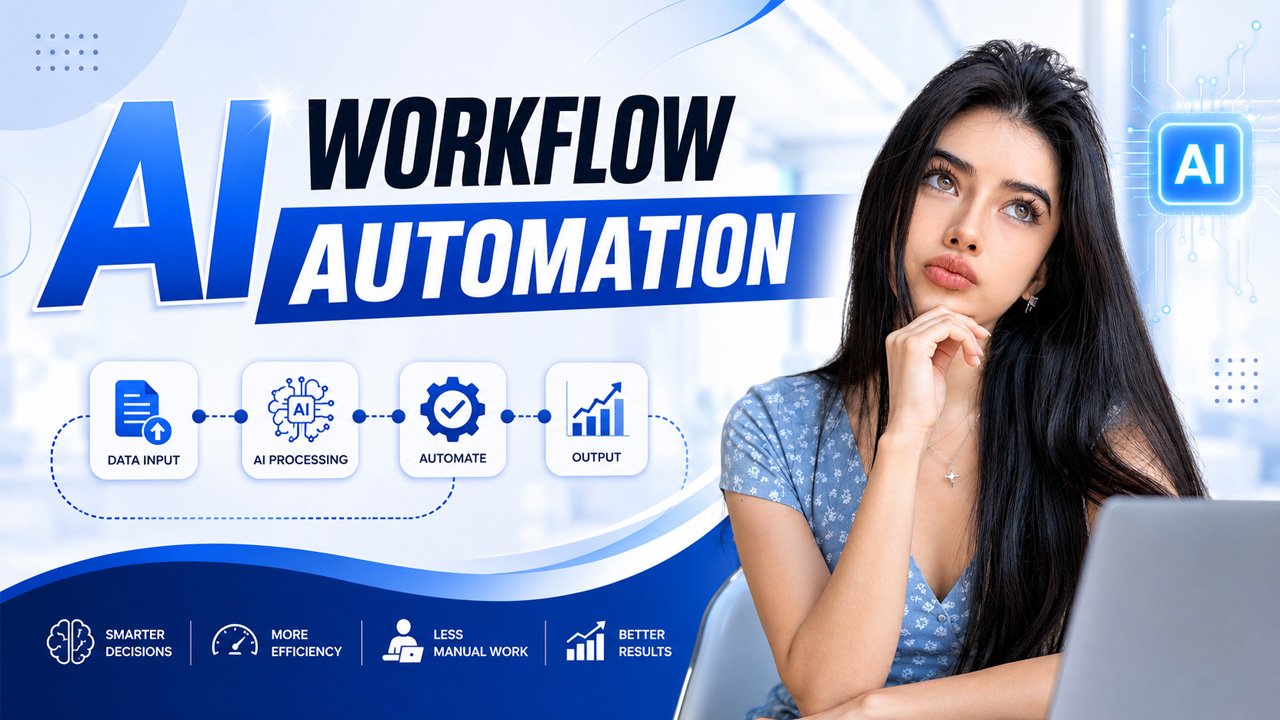
Today, most organizations find themselves surrounded by a variety of applications, an ocean of data, and constantly growing workflow complexity. Traditionally, workflow automation helped in handling all of that, but this technology was inherently limited, relying on static rules that could not change in more advanced cases. That’s exactly the gap AI Workflow Automation steps in to fill.
This approach does not rely on a fixed process anymore but involves intelligence that allows learning from data and making decisions based on context and current circumstances.
In this blog, we will talk about the essence of AI-driven workflow automation, discuss the most effective AI workflow automation, discuss the most effective AI workflow automation software currently available, and provide some use cases for artificial intelligence automation.
What is AI Workflow Automation?
AI workflow automation is an approach to automating various tasks and processes with the help of artificial intelligence in different systems and organisations, instead of utilizing standard manual procedures. The distinction between the two approaches mainly lies in their operating principles. Traditional automation works according to certain predefined algorithms, while AI-enabled automation learns from data and changes its behaviour based on that learning.
As a result, this approach is able to automate much more complicated procedures that require context awareness, decision-making, and execution of actions across several systems.
For example, when onboarding a new employee, it will become possible to use AI workflow automation to automatically provision the necessary software, assign the employee appropriate credentials, and change the corresponding records in several platforms at once. The tedious and manual work done by HR or IT staff is now being automated by an algorithm in a matter of seconds.
How AI-Powered Workflow Automation Works
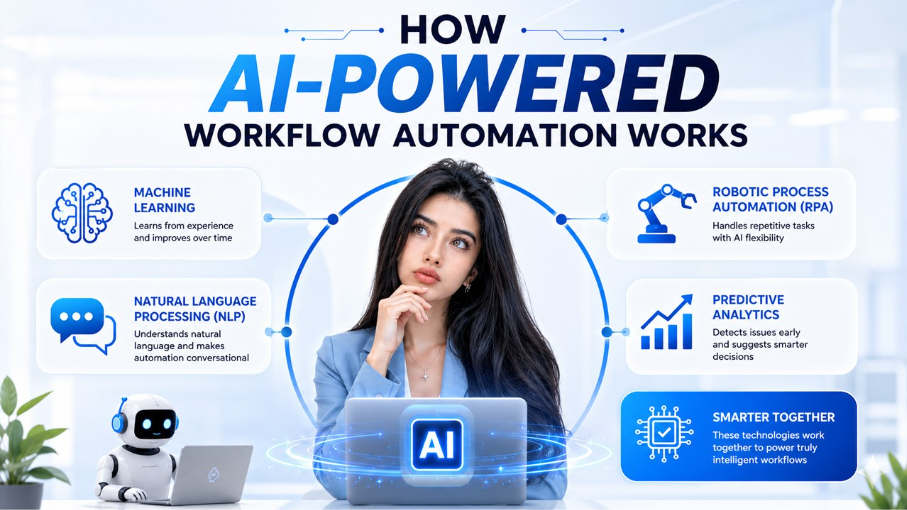
Under the hood of AI-driven workflow automation, a set of technologies is being used to turn the process into an actual intelligent one, not just based on rules.
Machine learning :
makes it possible for the systems to learn from experience and get better at pattern recognition and workflow optimization over time.
Natural language processing (NLP) :
enables the systems to understand natural language, thus making it easy for employees to type or say their request, instead of dealing with difficult interfaces. It turns AI automation into a conversation.
Robotic Process Automation (RPA) :
is responsible for repetitive, rule-based processes such as data entry, but becomes much more flexible when applied alongside AI, capable of dealing with exceptions and not failing at the first unexpected input.
Predictive analytics :
detects potential problems ahead of time and suggests data-supported ways to improve performance.
Overall, the combination of these technologies allows to create truly intelligent workflow automation.
Benefits of AI Workflow Automation
Implementing AI-driven workflow automation allows for many real benefits that can go far beyond increasing productivity by simplifying some tasks and reducing the need to perform them.
- Increased operational efficiency allows for a decrease in the time spent on routine tasks and gives employees an opportunity to do something more important and valuable.
- Increased productivity can lead to improved performance of the employees, which results in real cost savings.
- Increased consistency ensures that the same process is performed throughout all departments and locations and reduces mistakes along the way.
- Better employee support experience provides quick answers to typical questions of employees not involving support team.
- Scalability adjusts to changing needs of the business and unusual situations without additional human involvement.
- Improved over time gets better with every day it is used thanks to learning the real use case of it.
To summarize, implementing AI-driven workflow automation does more than just speed things up; it improves consistency and helps teams focus on higher-value work.
Common AI Workflow Automation Tools
There’s no shortage of AI workflow automation tools out there today, and most fall into a few broad categories depending on what kind of work they’re handling.
Generative AI:
Applications that assist in generating content, conducting data analysis, and delivering instant research findings for the purpose of accelerating the processes in marketing and reporting.
Chatbots and Conversational AI:
Assist in processing repetitive communication processes such as customer service tickets, HR communication, and simple sales conversations through natural interaction.
Robotic process automation applications:
Best to be applied in repetitive, rules-based activities such as data entry, document management, and reporting.
AI assistants:
Considered some of the best AI tools available right now, combining multiple AI capabilities to handle more complex, end-to-end workflows.
AISuites and integrated platforms:
Bundle several automation capabilities together, making it easier for businesses to manage different workflows from one place instead of juggling separate tools
Choosing the right mix usually comes down to the complexity of the task at hand; simple, repetitive work often suits RPA just fine, while more nuanced processes benefit from AI assistants or broader platforms like AISuites that bring multiple capabilities together.
Real-World Use Cases of AI Workflow Automation
Workflow automation by means of artificial intelligence is already creating some significant impacts in various fields within companies. Some departments experience particularly drastic changes due to the implementation of this technology.
In human resources, teams are usually flooded with repetitive requests related to vacation permission, benefits enrolment, and onboarding. In the case of the automated workflow, all of the above-mentioned processes will be carried out automatically with the help of a conversation interface, which will allow the HR department to concentrate on other aspects of their activities besides bureaucracy.
IT departments are provided with the possibility to get rid of routine activities like resetting passwords or providing access to certain software. Artificial Intelligence is able to carry out proactive monitoring of the devices, detect possible problems in advance, and fix them without any human intervention.
Sales departments also benefit from artificial intelligence that allows them to automate such boring activities as updating CRM information, scheduling meetings, and sending quotes to customers.
Challenges of AI Workflow Automation
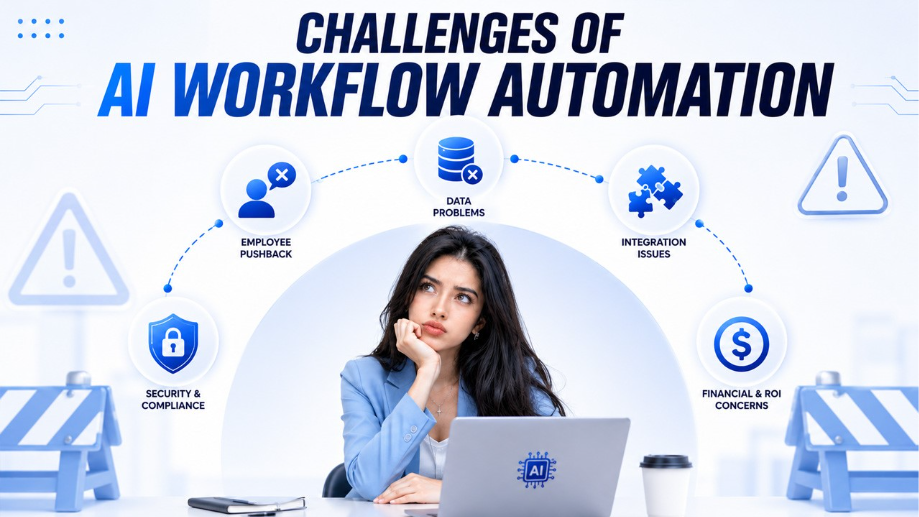
While this all sounds highly promising, implementing AI-driven workflow automation is far from problem-free, and knowledge of what to expect can definitely help.
- Employee pushback: This is a fairly common reaction among those who are concerned with their job stability and worried about changes in their workflow.
- Data problems: AI technologies are highly dependent on high-quality data; thus, poor or inconsistent data may affect the efficiency of automation.
- Integration issues: The integration of existing legacy systems with new automation solutions may prove to be challenging.
- Security and compliance: There are certain industries where additional data protection standards have to be taken into consideration during the implementation.
- Financial issues and return on investment: There should be some real investments made in AI automation technology implementation.
The positive thing is that none of the challenges mentioned above is really a blocker; they simply need to be planned for.
AI in Business Operations: Why it Matters
At this stage, AI workflow automation is no longer an optional advantage but becomes a core part of operations itself. As companies find it harder and harder to keep up with these changes using only old methods and systems.
Here, AI in Business Operations becomes especially valuable since instead of considering the possibility of automation for particular departments, companies start implementing AI in the very foundation of their business operations. This is not about replacing people but getting rid of time-consuming actions and allowing employees to focus on more important activities.
As such integration continues, businesses that consider AI-powered automation as a tool for improving business operations and use it consistently manage to achieve much better results than those that automate only certain parts of their activities.
Conclusion
It is obvious now that AI workflow automation goes beyond being one more buzzword; it is becoming an important tool that allows organizations to streamline their operations. The use of intelligent software to automate processes previously executed according to inflexible pre-set rules allows organizations to operate faster and error-free and helps free their employees for performing truly human tasks.
By now, we have considered what AI workflow automation means in practice, what key technological components it comprises, as well as what tangible benefits it can offer. Moreover, we have provided information on some of the best AI workflow automation solutions. Additionally, we have described the examples of practical use of AI workflow automation in HR, IT, and sales departments and discussed the main challenges organizations should prepare for.
Thus, the use of AI for workflow automation does not mean the replacement of human staff; it means making space for employees to focus on tasks that are worth their efforts.
Frequently Asked Questions :
Q. What is AI workflow automation?
AI workflow automation uses artificial intelligence to streamline tasks and processes across systems, learning from data and adapting over time instead of following fixed, predefined rules.
Q. How is AI-powered workflow automation different from traditional automation?
Traditional automation relies on static, rule-based steps, while AI-powered automation learns from experience, understands context, and can make decisions across complex, multi-step processes.
Q. What are some examples of AI workflow automation tools?
Common examples include generative AI platforms, conversational AI chatbots, robotic process automation (RPA) tools, AI assistants, and integrated platforms like AISuites.
Q. What are the main benefits of AI workflow automation?
It improves efficiency, boosts productivity, ensures consistency across departments, strengthens scalability, and continuously improves based on real usage over time.
Q. What challenges should businesses expect when adopting AI workflow automation?
Common challenges include employee resistance, data quality issues, integration difficulties with legacy systems, compliance requirements, and ensuring a strong return on investment.