
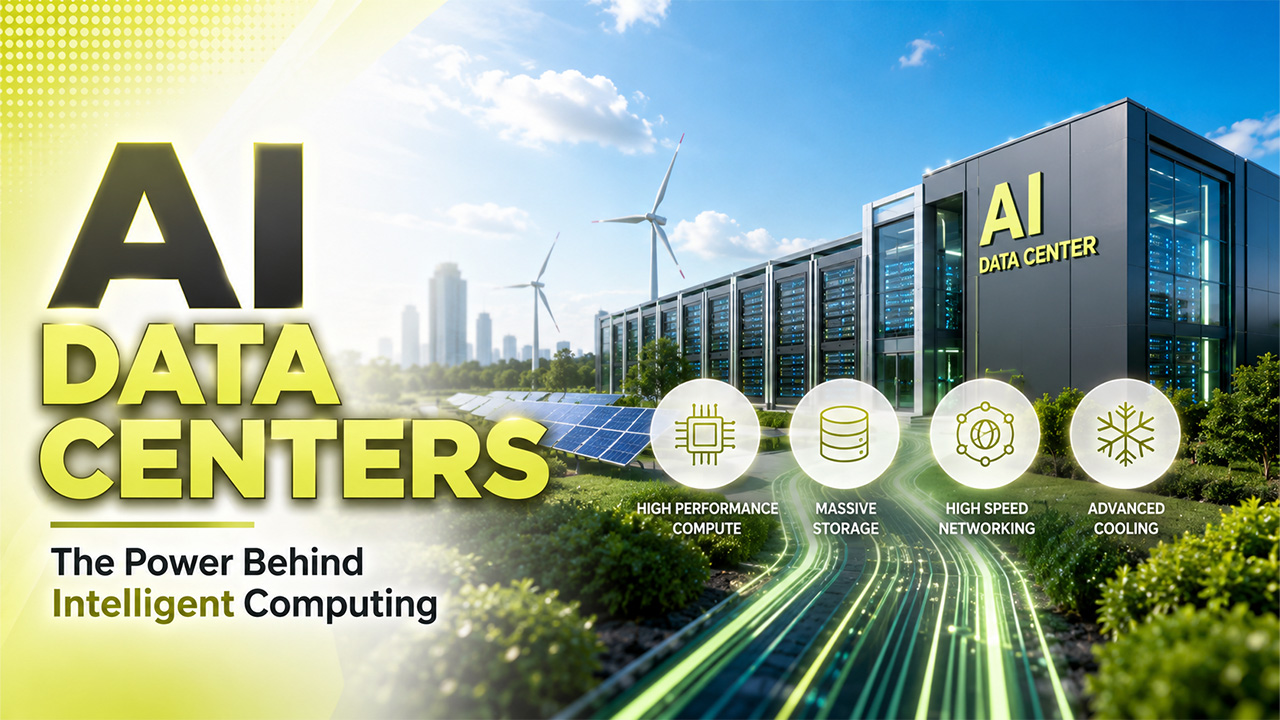
Each AI-driven application, ranging from chatbots to recommendation systems, depends on a massive volume of computing power operating in the background. This power stems from purpose-built facilities to manage intensive deep learning and machine learning workloads. AI Data Centers are the pillar of this fast transformation, providing the storage, computation, and networking capacity to train as well as implement AI technology at a great scale. As businesses greatly adjust AI tools for automation, content creation, and decision-making, understanding the function of these facilities has become vital for anyone working on digital marketing or technology.
What Are AI Data Centers?
AI Data Centers are purpose-built facilities created to provide support to the unique demands of AI workloads. Contrary to conventional data centers primarily building around CPUs (Central Processing Units) for general computing tasks, such facilities are built around high-performance graphics processing units (GPUs) and Tensor Processing Units (TPUs) that expedite deep learning and machine learning processes.
Such facilities integrate numerous vital elements:
- High-density compute hardware specialized for parallel processing.
- High-speed and advanced storage platforms.
- High-bandwidth and low-latency networking.
- Specialized systems for power management and cooling.
The increasing demand for natural language processing, generative AI, and computer vision applications has encouraged businesses to rethink how they design as well as operate their own infrastructure, making AI data centers a central topic in enterprise technology planning.
Main Components That Differentiate Between AI Data Centers
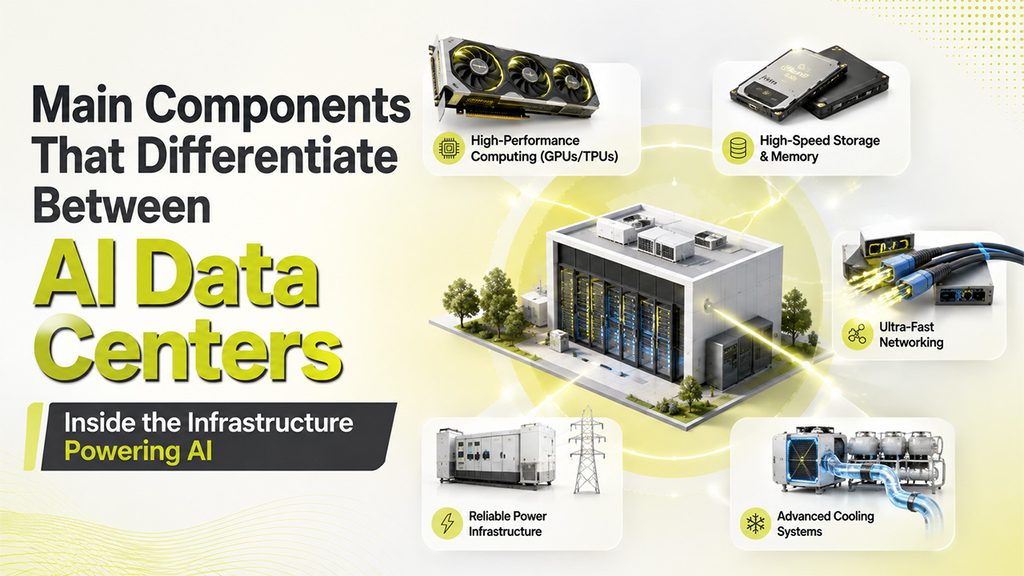
Developing infrastructure, which is capable of providing support to AI workloads, needs far more than just upgrading a few servers. The main components of AI data centers collaborate together to manage extensive computational requirements without any bottlenecks.
High-Performance Computing Hardware
AI accelerators like TPUs and GPUs form the backbone of such facilities. GPUs break complex problems into smaller tasks that can operate concurrently, a process known as parallel processing, making them ideal for training large AI models. Meanwhile, TPUs are custom-built to accelerate tensor computations, which are common in deep learning applications. These powerful technologies also support data-intensive solutions such as IoT App Development, where AI can help process and analyze large volumes of data generated by connected devices.
Sophisticated Storage Architecture
AI workloads create as well as consume copious volumes of data. To keep up with it, such facilities depend on:
- High-speed SSDs (Solid-State Drives), specifically NVMe SSDs.
- HBM, i.e., High-bandwidth memory for quicker transfer of data.
- Virtualized storage platforms that adjust to evolving demands.
Resilient Networking
Since AI apps generally need near-instant responses, networking within AI data centers need to support high throughput with minimum latency. This is specifically vital for hyperscale facilities handling distributed training across thousands of processors simultaneously. For teams that explore how AI platforms ensure connected and fast experiences across content, search, and automation tools, check out AISuites’ all-in-one AI workspace, which showcase how this backend infrastructure ensures practical tools which you can use daily.
Power and Cooling Systems
The vast computational intensity of AI hardware creates great heat and consumes considerable electricity. Numerous facilities now leverage immersion cooling, liquid cooling, or cold and hot aisle containment to efficiently handle thermal loads while ensuring that operational costs remain in check.
AI Data Centers vs. Traditional Data Centers
While AI data centers share a few similarities with traditional facilities, like the need for security, reliability, and energy efficiency, the differences cannot be ignored once you take workload intensity into the account-
- Focus on Hardware: Conventional data centers mainly depend on CPUs, while AI-powered facilities rely on TPUs and GPUs for parallel processing.
- Energy Consumption: GPUs utilized in AI facilities can consume substantially more power per processing cycle when compared to CPUs in standard setups.
- Space Needs: The sheer volume of purpose-built hardware required for AI workloads generally requires more physical square footage.
- Deployment Models: Businesses can choose from cloud-based, on-premises, or hybrid approaches as per scalability objectives, compliance requirements, and budget.
Numerous businesses also compare hyperscale versus colocation strategies. Hyperscale facilities, generally operated by different cloud providers, are built for large-scale and massive AI training processes. On the other hand, Colocation facilities enable companies to render power, space, and bandwidth within a shared ecosystem, making sophisticated infrastructure accessible without substantial upfront investment. This flexibility has increased demand across distinct industries, a trend further explored in our blog how evolving AI is transforming modern businesses.
Why Are AI Data Centers Important for the Future?
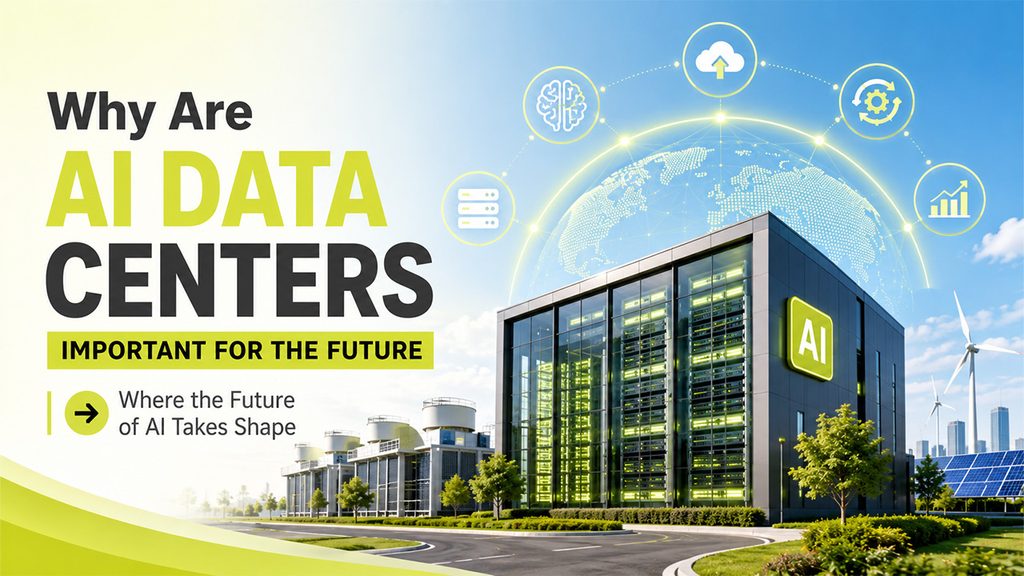
The growth of AI data centers showcases the wider shift toward AI-powered services and products. As more organizations incorporate automation, generative AI, and smarter search into daily operations, the infrastructure that provides support to these tools must scale accordingly.
A few factors that are transforming this growth:
- Increasing adoption of LLM models and generative AI applications across different industries.
- Better investment from major tech-centric organizations in new data center construction.
- Better focus on sustainability, with businesses exploring sources of renewal energy and efficient cooling methods.
- Edge computing expansion to minimize latency for real-time AI applications.
This infrastructure buildout supports the AI tools like Claude or ChatGPT directly that professionals now leverage for daily tasks, whether that is for formulating marketing strategies or creating content through connected AI workspaces. As dependence on these tools continues to evolve, the underlying facilities will continue to expand in sophistication and scale.
Conclusion
AI Data Centers showcase a basic shift in how businesses create and handle computing infrastructure. By integrating high-performance hardware, sophisticated storage, resilient network, and effective power management, such facilities make it possible to train as well as deploy the AI applications that are transforming industries nowadays. As demand for AI continues to grow, businesses that comprehend the significance of AI data centers will be more effectively positioned to make data-driven decisions about cost, scalability, and long-term tech strategy. Irrespective of whether through hybrid deployments or hyperscale providers, the infrastructure choices made today will transform the pace of AI innovation in future.